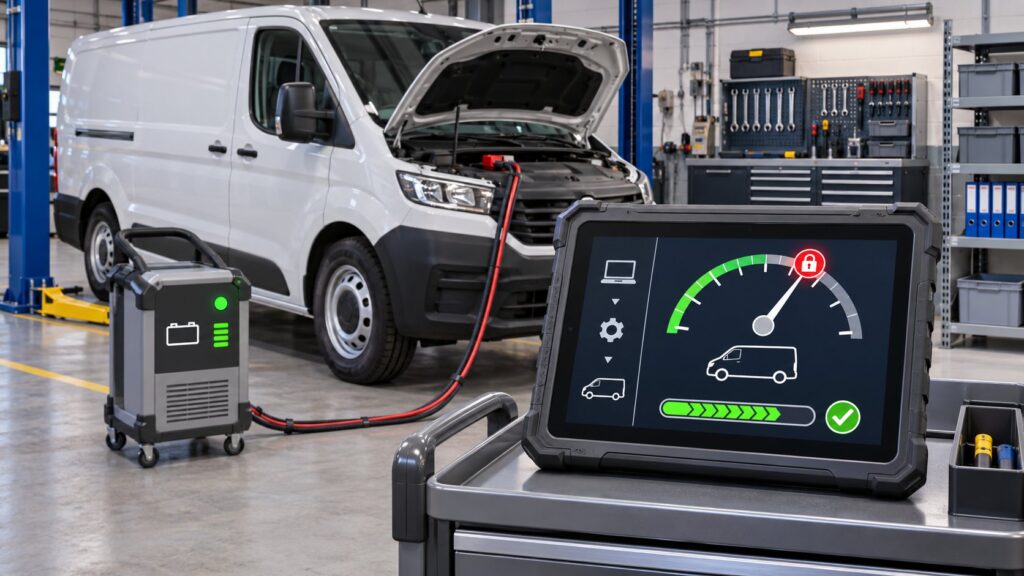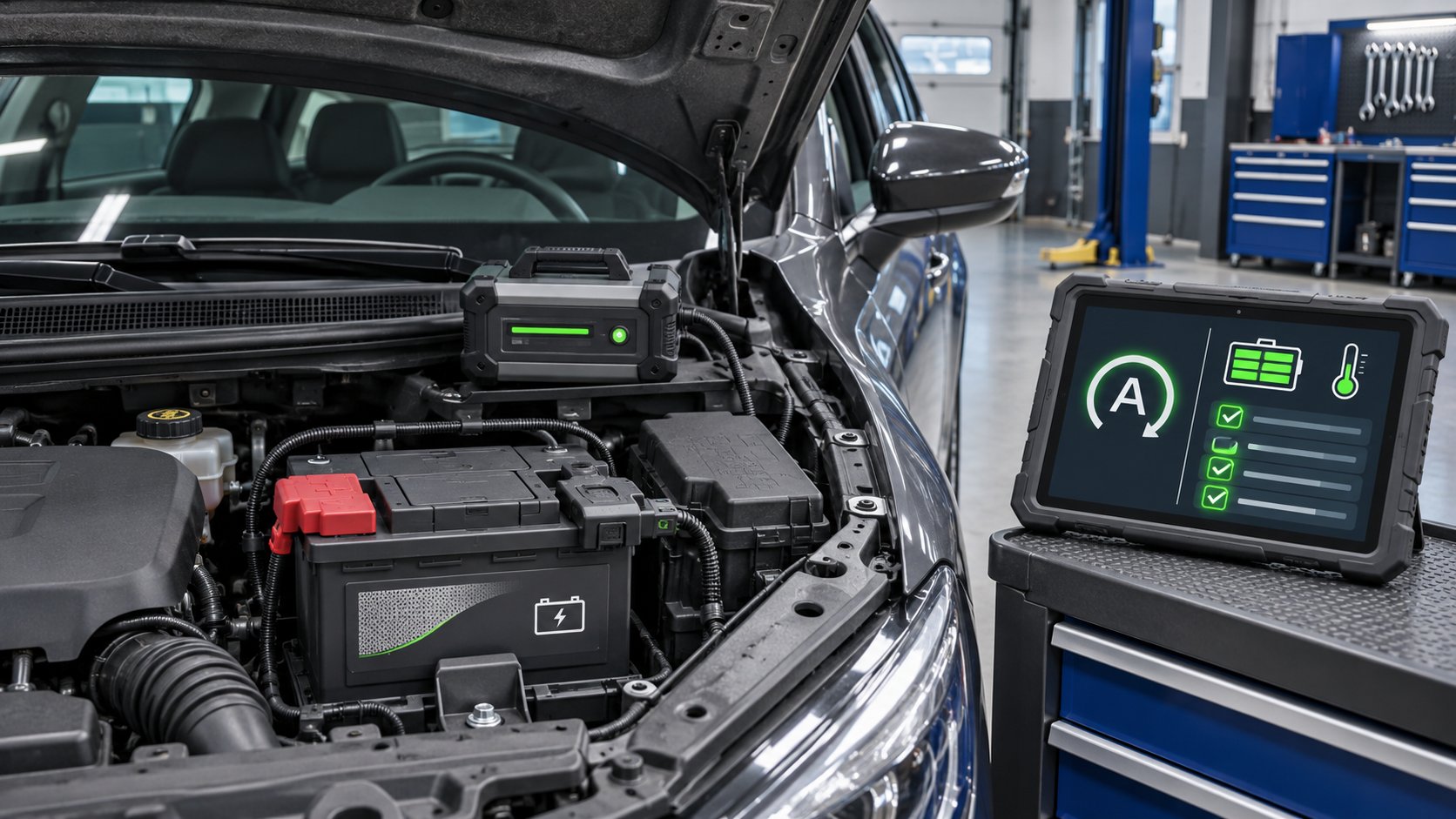
A stop start reset may appear in a scan tool after battery replacement, but automatic stop/start depends on more than one stored value. The vehicle may need battery registration, battery-sensor learning, a model-specific service function or simply time to rebuild an accurate state-of-charge estimate. It may also keep the engine running because temperature, climate demand or another normal enable condition is not satisfied.
Pressing reset without identifying the reason for the inhibition can hide the real problem. Begin with the owner’s manual and service information for the exact VIN, battery type and powertrain. Check diagnostic faults and live data before changing learned values.
Why automatic stop/start has so many enable conditions
The system must be confident that the engine can restart quickly and safely. It therefore evaluates battery state, temperatures, brake or vacuum support, driver inputs, vehicle position and electrical demand. The exact list varies, but common conditions include:
| Tilstand | Why it matters | What the driver may notice |
|---|---|---|
| Battery state of charge and health | Reserves enough energy for reliable restart and vehicle loads | Engine stays running after battery work or short trips |
| Battery temperature and ambient temperature | Charging and starting performance change with temperature | System unavailable in very hot or cold conditions |
| Cabin heating, cooling or defrost demand | Keeps climate and visibility systems effective | Engine restarts or does not stop while climate demand is high |
| Engine temperature and emissions operation | Allows warm-up and required emissions processes | No auto stop early in a journey |
| Door, hood, seatbelt, brake and steering inputs | Confirms safe operating conditions | Indicator shows unavailable until inputs are correct |
| Stored faults or communication problems | Prevents operation when required modules or sensors cannot be trusted | Warning message, fault code or persistent inhibition |
Hyundai’s Idle Stop & Go bulletin 19-FL-002H lists battery charge, ambient and coolant temperature, brake vacuum, doors, seatbelt, slope, steering angle and fault status among the prerequisites on the specified vehicle. Ford owner guidance likewise notes that a low battery charge or high climate demand can prevent an engine stop. Temporary unavailability under those conditions is normal behavior, not proof that a reset is missing.
Battery registration, sensor learning and stop/start reset differ
| Service operation | Main purpose |
|---|---|
| Battery registration or replacement record | Tells a supported vehicle that a new battery was installed and may record capacity, chemistry or related data |
| BMS or battery-monitor reset | Clears or initializes learned battery-management values where the OEM procedure requires it |
| Battery-sensor recalibration | Allows an intelligent battery sensor to rebuild stable state-of-charge and state-of-health information |
| Stop/start reset | Runs a vehicle-specific initialization or reset exposed by the diagnostic system |
These labels are not universal. Our guide to battery registration versus BMS reset explains the battery-management side in more detail. A vehicle can require battery registration without offering a separate stop/start reset, while another may use a guided procedure with several related steps.
Why stop/start can remain unavailable after battery replacement
The new battery may be undercharged, the wrong specification, or not yet recognized accurately by the monitoring system. The intelligent battery sensor may have lost its learn status when its connector or negative-terminal assembly was disturbed. A parasitic draw can prevent learning from completing. Faults in the charging system, battery sensor, LIN communication or another required module can also inhibit the feature.
GM bulletin 15-NA-087 explains that disconnecting the battery sensor resets its learn status on the covered vehicles, excessive draw can prevent the learn from completing, and low state of charge disables stop/start. GM bulletin 22-NA-214 similarly connects stop/start availability to accurate battery-sensor data and tells technicians to review the vehicle’s disable, inhibit and restart reasons.
A practical diagnostic sequence
- Confirm the battery installation. Verify the specified battery technology, capacity, terminal security and sensor connection. Do not assume a battery that physically fits is correct.
- Test battery charge and charging performance. A new battery can arrive below full charge. Use the manufacturer’s approved test and charging method.
- Scan every relevant module. Record faults in the engine, body, battery-monitor, gateway and charging systems before clearing anything.
- Read inhibit data. Where supported, inspect stop/start disable reasons, state of charge, temperature, sensor learn status and abnormal current draw.
- Perform only the specified service function. Complete battery registration, BMS reset, sensor relearn or stop/start initialization exactly as the OEM procedure directs.
- Allow required learning time. Some systems need an undisturbed rest period after battery work. Follow the applicable ignition, door, hood and sleep-state conditions.
- Recheck under valid conditions. Test only after charge, temperature, climate demand, driver inputs and other prerequisites are satisfied. Confirm that faults do not return.
Safety around automatic restart
An engine in auto-stop mode can restart without a conventional key action. Hyundai’s bulletin warns against working in the engine compartment with the ignition in ON or ACC because the engine may start without warning. Switch the ignition fully off, remove keys or remotes as directed, secure the vehicle and follow the service manual before touching the battery or engine bay.
Use appropriate battery protection and observe polarity. Do not disconnect an intelligent battery sensor merely to force a relearn; OEM bulletins show that doing so can erase learn status and create additional diagnostic work.
Choosing a diagnostic tool
Den nuværende XTOOL D7 V2.0 og XTOOL D7S V2.0 listings both include Stop/Start Reset. Coverage still varies by make, model, year and system. Confirm that the tool supports the exact vehicle and required battery function before purchase or service.
Vores active-tests and service-functions guide explains why seeing a menu category does not guarantee universal coverage. Compare other equipment in the kategorien »diagnostiske værktøjer«.
Stop/start reset FAQ
Will a reset make stop/start work immediately?
Not always. The battery may need charging or sensor learning, and all normal enable conditions must be satisfied.
Is a BMS reset the same as a stop/start reset?
No. They may be related in a replacement workflow, but the labels describe different system functions.
Does an unavailable message prove a fault?
No. Climate demand, temperature, battery state and driver inputs can temporarily inhibit operation. A warning that persists under valid conditions should be diagnosed.
A stop start reset is useful only when the vehicle’s service procedure calls for it. Verify the battery, diagnose faults, identify the actual inhibit reason, complete the correct battery-management steps and allow the required learning before judging the result.