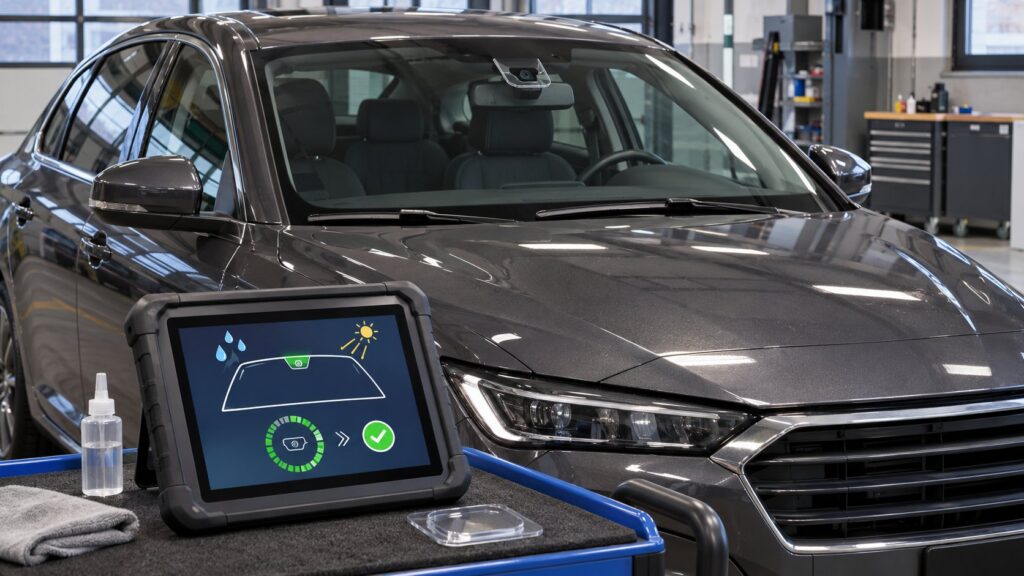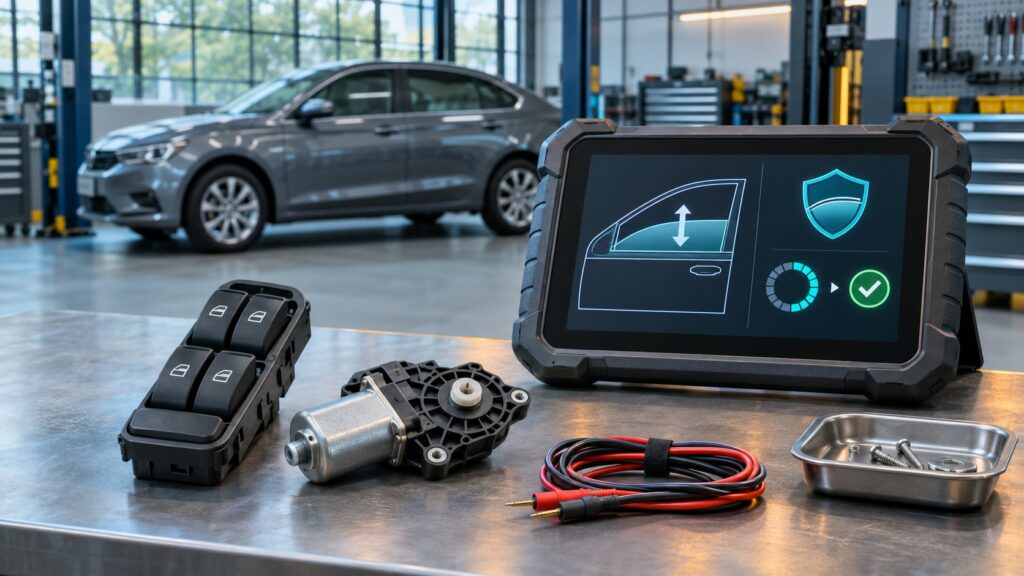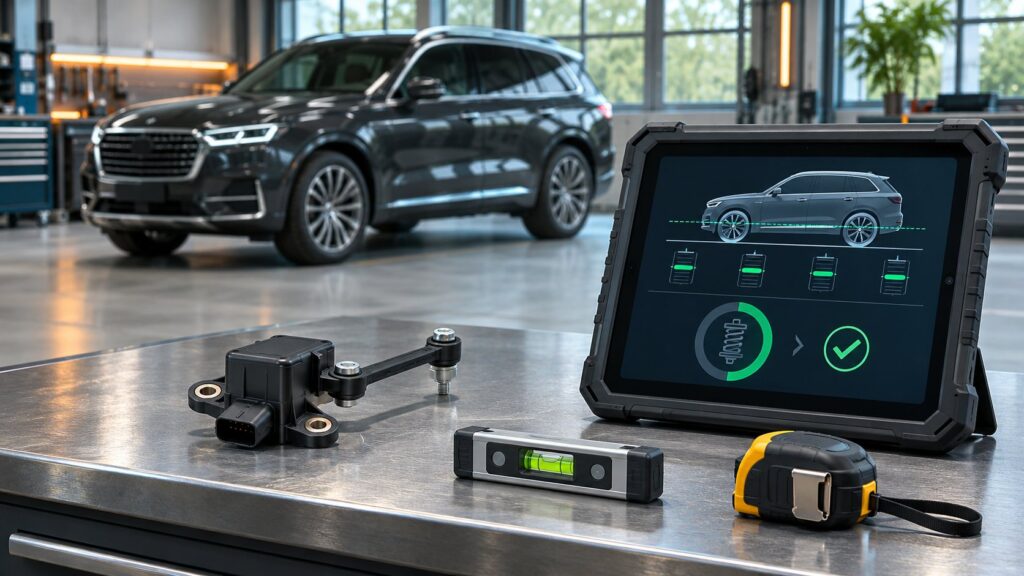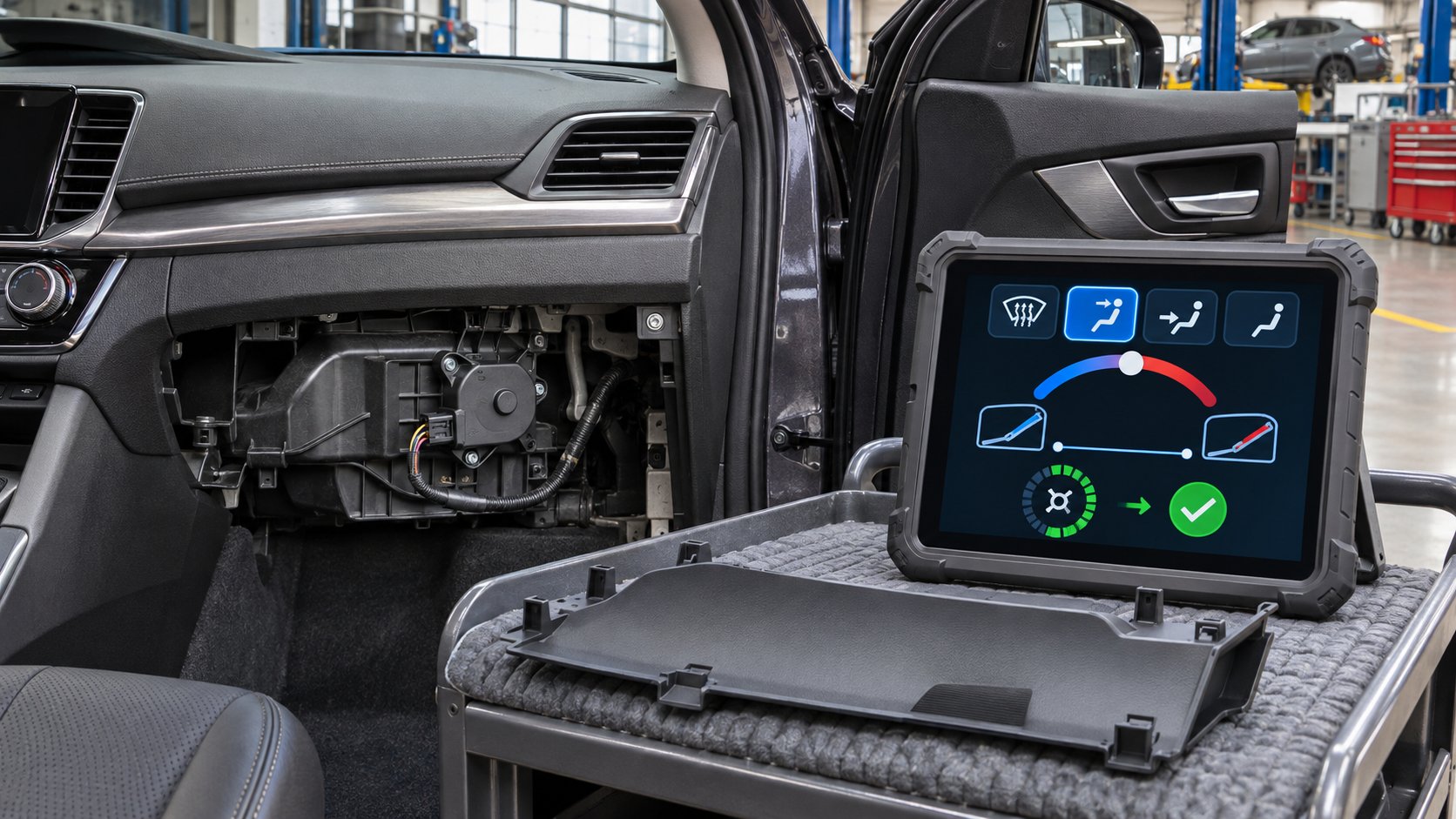
AC actuator relearn teaches a vehicle’s HVAC control module the end positions of the small motors that move temperature, mode and recirculation doors. On vehicles that require it, calibration may be needed after low voltage, battery disconnection, actuator replacement, HVAC-module programming or work inside the air-distribution case.
A relearn cannot repair a broken blend door, stripped gear, binding linkage, faulty motor, damaged wiring or low refrigerant charge. Correct diagnosis matters because several very different faults can produce the same complaint: clicking behind the dashboard, airflow from the wrong vents or one side staying hot.
What does an HVAC actuator learn?
An HVAC case contains doors that direct air through the heater core, evaporator and selected vents. Depending on the system, electric actuators can control left and right temperature, panel/floor/defrost mode, fresh-air intake, recirculation and rear climate zones.
During calibration, the control module moves an actuator through its expected range and stores position references. A Kenworth technical bulletin describes HVAC actuators entering calibration mode and travelling from end stop to end stop with the blower off. That movement helps the controller relate actuator feedback to physical door position.
When can an A/C relearn be required?
- after replacing a blend, mode, recirculation or temperature-door actuator;
- after replacing or programming the HVAC control module or related body controller;
- after battery disconnection or low voltage when the vehicle procedure identifies lost calibration;
- after HVAC case, door or linkage work that changes actuator travel;
- when diagnostic codes report range, position or calibration faults; or
- when current service information directs a relearn after a specific repair.
Do not assume every battery replacement requires calibration. Some controllers retain learned positions, and some perform an automatic cycle. A General Motors bulletin for a covered vehicle explains that low battery voltage, battery disconnection or a control-module flash can set HVAC actuator codes. Its diagnostic sequence clears and retests the system, then uses a scan-tool actuator relearn if faults return.
What relearn cannot repair
Calibration cannot overcome a door that is physically jammed, a shaft that has cracked, gears that skip, a motor that stalls, a loose connector, poor ground or a control module that cannot communicate. Repeatedly driving a faulty mechanism against its stops can worsen gear damage or overheat an actuator.
Clicking does not automatically mean the learned position is wrong. A GM diagnostic bulletin traces certain mode complaints and clicking to cable routing that restricts door travel. It directs technicians to observe actuator movement and confirm airflow at the vents. A reset would not move an obstructing cable.
Binding can also be inside the case. A 2024 GM bulletin says a ticking rear HVAC concern on specified vehicles can come from a mode door binding where it passes through the case. The prescribed check removes the actuator and verifies the door moves freely; a binding door requires mechanical repair.
A practical diagnostic workflow
- Record the exact complaint. Test every temperature zone, vent mode, fan speed, recirculation setting and rear control. Note when clicking begins and whether a battery or dashboard repair preceded it.
- Scan before clearing codes. Save HVAC, body and gateway faults. Review commanded and actual actuator positions, switch inputs and temperature-sensor data when available.
- Separate airflow from cooling. Confirm whether the problem is door position, blower output, heater operation or refrigerant performance. A calibration cannot correct a refrigerant leak or compressor fault.
- Check electrical basics. Verify battery voltage, fuses, grounds, connectors and module communication. Low voltage during learning can interrupt the cycle.
- Inspect the mechanism. Where access permits, watch the actuator and check its linkage. With the actuator removed only as the service procedure allows, verify the door moves freely without forcing it.
- Confirm the required routine. Use current instructions for the VIN and HVAC option. Identify prerequisites such as blower state, control settings, ignition mode and stable battery support.
- Clear the work area. Keep fingers, wiring and tools away from gears and door levers. Reinstall or secure trim and connectors as required before any automatic movement.
- Calibrate and verify. Let the full routine finish without operating controls. Recheck codes, actual positions, outlet temperature and airflow from every specified vent.
Why calibration may fail
A routine can fail when an actuator cannot reach an expected endpoint, position feedback is implausible, voltage drops, the wrong actuator is installed or a door binds. A missing connector or damaged circuit can create the same result. Save the failure code or status rather than repeating the routine blindly.
Software level can matter too. A Stellantis HVAC bulletin specifies module reprogramming followed by an actuator-calibration test on the covered vehicles, with controlled battery voltage during the flash. That sequence belongs to those applications; it is not a universal instruction to update every vehicle with a blend-door complaint.
Actuator tests and relearn are different
A bidirectional actuator test commands a component or valve to help confirm whether the module can operate it. A relearn moves through a prescribed sequence and stores position references. Passing one test does not prove that the door, airflow or refrigerant system is healthy.
A Mitsubishi diagnostic procedure demonstrates this distinction by using scan-tool actuator testing within a broader fault tree, followed by circuit, relay and component checks when the commanded item does not respond. Diagnosis continues beyond the screen result.
Safety around the dashboard and HVAC case
Actuator gears and levers can move automatically during calibration. Keep hands and loose items away. If trim, glovebox parts or dashboard panels are removed, follow the manufacturer’s battery-disconnection and supplemental-restraint precautions; never probe airbag wiring with an ordinary test light.
HVAC door calibration does not require opening the refrigerant circuit. Refrigerant recovery, evacuation and charging require specified equipment and trained handling. Do not release refrigerant or use a pressure reading as a substitute for correct system diagnosis.
Manual cycle vs scan-tool relearn
Some vehicles calibrate automatically after a defined ignition or control sequence. Others require a service routine that identifies each actuator, checks prerequisites and reports success or a failure reason. Tool coverage depends on make, model, year, HVAC option and software.
The current SpeedXperts listings for the XTOOL D7S V2.0 ja XTOOL D7 V2.0 include “A/C Relearn.” Confirm the exact vehicle and function before purchase or service.
Browse the diagnostiikkatyökalujen kokoelma and read our guide to active tests and service functions. The distinction is especially useful when an actuator moves on command but cannot complete calibration.
Usein kysyttyjä kysymyksiä
Does battery disconnection always require an HVAC relearn?
No. Check current service information and scan status for the exact vehicle.
Will relearn stop dashboard clicking?
Only if lost position is the cause. Binding doors, stripped gears and obstructed linkages require physical repair.
Can calibration fix weak air conditioning?
It can correct airflow direction or temperature-door position when learning is missing. It cannot repair low refrigerant, compressor, condenser, evaporator or sensor faults.
AC actuator relearn belongs at the end of a sound repair. Prove the doors move freely, verify electrical and HVAC basics, run the exact routine and confirm every outlet and temperature zone before returning the vehicle.