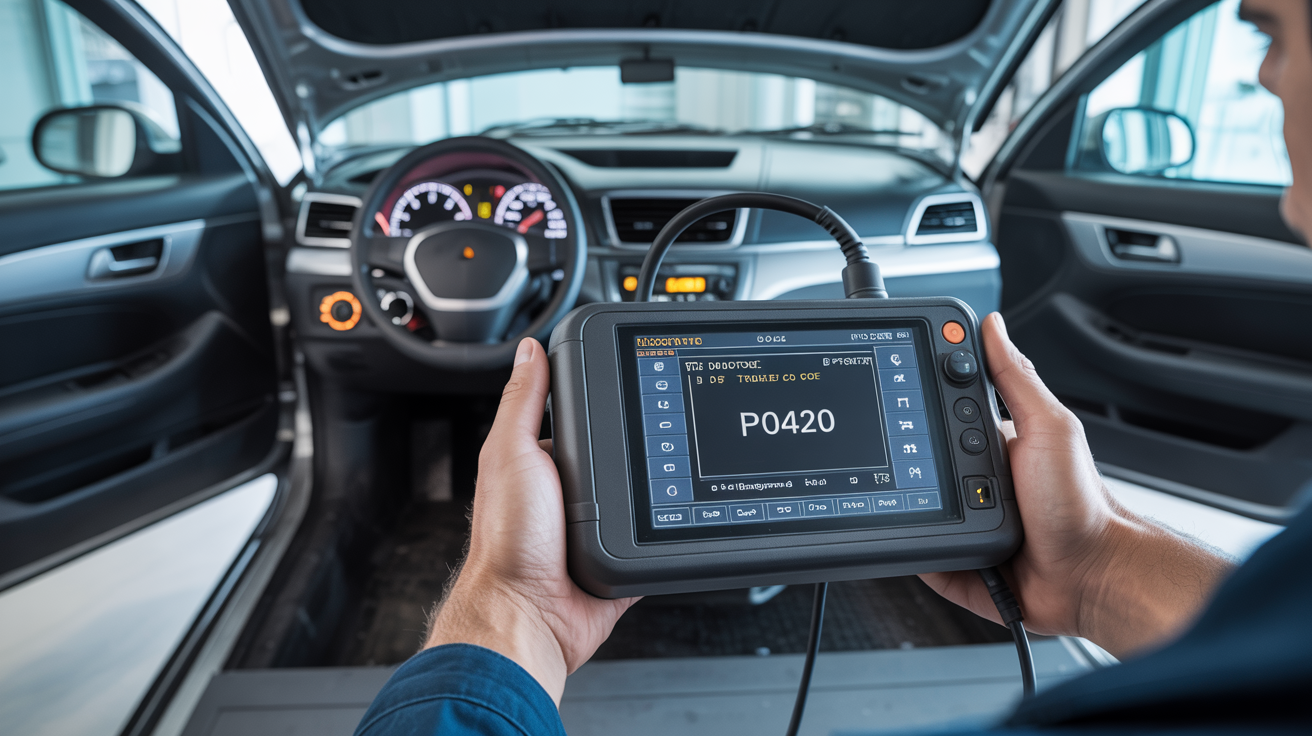
You’re driving to work when suddenly that amber glow appears on your dashboard — the check engine light. Your stomach drops. Is it serious? Will the car break down? How much is this going to cost? Before you panic or rush to the nearest garage, take a breath. In most cases, a check engine light is your car’s way of flagging a specific, diagnosable issue — and with the right OBD2 approach, you can identify the root cause yourself in under 10 minutes.
This guide walks you through exactly what to do when your check engine light comes on: from the free visual checks you should do first, to reading and interpreting OBD2 fault codes, to understanding live sensor data that tells the real story behind the warning.
Step 1: Don’t Panic — Read the Light First
Not all check engine lights are equal. The first thing to determine is whether the light is steady or flashing/blinking.
- Steady amber light: A non-urgent fault has been detected. The vehicle is safe to drive short distances, but diagnosis should happen soon.
- Flashing/blinking light: This indicates an active engine misfire severe enough to damage the catalytic converter. Pull over safely and do not continue driving until diagnosed.
- Red check engine light (some manufacturers): Treat as urgent — stop driving and investigate immediately.
Also check your other gauges: oil pressure, coolant temperature, and battery voltage. If any of these are abnormal alongside the check engine light, the situation is more serious.
Step 2: Free Visual Checks Before Plugging In
Before reaching for a diagnostic tool, do a quick walk-around and under-hood inspection. These free checks resolve a surprising number of check engine light triggers:
- Gas cap: A loose, cracked, or missing fuel cap is one of the most common causes of a check engine light (EVAP system codes P0440, P0455). Remove it, inspect the seal, and retighten until you hear it click.
- Oil level and condition: Low oil can trigger engine protection codes. Check the dipstick — oil should be between MIN and MAX marks and not black/gritty.
- Coolant level: Check the expansion tank. Low coolant can trigger temperature-related codes.
- Visible vacuum hoses: Look for cracked, disconnected, or collapsed rubber hoses around the intake manifold. Vacuum leaks cause lean mixture codes (P0171, P0174).
- Air filter housing: Ensure the air filter box is properly sealed. A loose housing causes MAF sensor errors.
If everything looks normal visually, it’s time to connect an OBD2 scanner.
Step 3: The OBD2 Diagnostic Decision Tree
The OBD2 port is your direct line to the vehicle’s Engine Control Unit (ECU). It’s standardized across all vehicles manufactured from 1996 onward and is typically located under the dashboard on the driver’s side, within 60 cm of the steering wheel.
How to Read Fault Codes
- Connect your scanner: Plug your OBD2 tool into the diagnostic port. The Vgate iCar Pro 2S is an excellent Bluetooth option that pairs with your smartphone for instant code reading on iOS, Android, and PC — including EV and hybrid support.
- Turn ignition to ON (engine off): This powers the ECU without starting the engine, allowing full communication.
- Read stored DTCs: The scanner will display Diagnostic Trouble Codes (DTCs). Note all codes — there may be multiple.
- Check freeze frame data: This snapshot captures sensor values at the exact moment the fault was triggered — invaluable for intermittent faults.
- Note pending codes: These are faults detected once but not yet confirmed. They indicate developing problems worth monitoring.
Decoding the DTC Structure
Every OBD2 code follows a standardized format: [Letter][0 or 1][System digit][Two fault digits]
- P = Powertrain (engine, transmission) — most common for check engine lights
- B = Body | C = Chassis | U = Network
- Second digit 0 = Generic/global code; 1 = Manufacturer-specific
- Third digit identifies the subsystem: 1-2 = Fuel/air metering; 3 = Ignition; 4 = Emissions; 5 = Speed/idle; 7-8 = Transmission
Diagnostic Branching by Code Category
Fuel/Air Codes (P01xx, P02xx): If you see P0171 (System Too Lean, Bank 1) or P0174 (System Too Lean, Bank 2), suspect a vacuum leak, dirty MAF sensor, or weak fuel pump. Check live fuel trim data — Short Term Fuel Trim (STFT) above +10% at idle confirms a lean condition.
Ignition/Misfire Codes (P030x): P0300 (random misfire) or P030x (cylinder-specific) point to spark plugs, ignition coils, or injectors. Use a professional multi-brand tool like the Delfi DS150e Premium 1PCB to access individual cylinder misfire counters and injector activation tests — capabilities beyond basic code readers.
Emissions Codes (P04xx): EVAP codes (P0440-P0457) often trace back to the fuel cap or purge valve. Catalytic converter codes (P0420, P0430) require O2 sensor waveform analysis — don’t replace the cat without confirming sensor operation first.
Sensor Codes (P01xx, P02xx): MAF, MAP, O2, and coolant temperature sensor codes are common. Cross-reference with live data to confirm whether the sensor reading is genuinely out of range or if the sensor itself is faulty.
Step 4: Live Data Interpretation — What the Numbers Tell You
Reading fault codes is only half the story. Live OBD2 data (PIDs — Parameter IDs) reveals what the engine is actually doing in real time. Here are the key PIDs to monitor and what to look for:
| PID | Normal Range | Abnormal Indication |
|---|---|---|
| Engine Coolant Temp (ECT) | 85–105°C at operating temp | Below 70°C = stuck-open thermostat; above 110°C = cooling issue |
| Short Term Fuel Trim (STFT) | ±5% at idle | >+10% = lean (vacuum leak/MAF); <-10% = rich (injector/sensor) |
| Long Term Fuel Trim (LTFT) | ±10% | Persistent deviation confirms chronic fuel mixture issue |
| MAF Sensor (g/s) | 2–7 g/s at idle; scales with RPM | Flat or erratic reading = dirty/failed MAF |
| O2 Sensor Voltage (upstream) | Switching 0.1–0.9V rapidly | Stuck high/low = failed sensor or mixture issue |
| Throttle Position (TPS) | 0% at idle, 100% WOT | Erratic or non-linear = dirty/failed TPS |
| Intake Air Temp (IAT) | Ambient ±10°C | Excessively high = heat soak or sensor fault |
Pro tip: Monitor fuel trims at idle vs. 2500 RPM. If STFT is high at idle but normalizes at higher RPM, the lean condition is likely a vacuum leak (more pronounced at idle vacuum). If it’s high at all RPMs, suspect a fuel delivery or MAF issue.
For deeper diagnostics — including bi-directional controls, actuator tests, and manufacturer-specific live data — the Wurt Wow Snooper Premium provides professional-grade coverage across hundreds of vehicle makes, giving you the same data access as a main dealer workshop.
Step 5: After Reading Codes — What Next?
- Research the specific code: Use resources like AutoCodes.com for detailed OBD2 code definitions, common causes, and diagnostic tips specific to your vehicle make.
- Check for Technical Service Bulletins (TSBs): Many check engine light issues have known fixes documented by manufacturers. A professional scanner can often access TSB data directly.
- Confirm before replacing: Never replace a sensor just because a code points to it. Confirm the fault with live data, component testing, or a wiring check first. This is the single biggest mistake DIYers make.
- Clear codes and retest: After repairs, clear the DTCs and drive through a complete drive cycle. If the light stays off and readiness monitors complete, the repair was successful.
- Persistent or complex faults: For multi-system faults or manufacturer-specific codes, a professional multi-brand diagnostic platform gives you the depth needed. Explore the full range at SpeedXperts Diagnostic Tools.
According to O’Reilly Auto Parts, a flashing check engine light should always be treated as urgent — it typically signals an active misfire that can destroy a catalytic converter within minutes of continued driving.
Frequently Asked Questions
Can I drive with the check engine light on?
If the light is steady (not flashing), you can typically drive short distances to get the vehicle diagnosed. However, avoid long trips or high-load driving until you know the cause. A flashing check engine light means stop driving immediately — it indicates a severe misfire that can cause expensive catalytic converter damage.
Will the check engine light go off by itself?
Sometimes. If the fault was intermittent (like a momentary sensor glitch or a loose gas cap that was retightened), the ECU may clear the code automatically after several successful drive cycles without the fault recurring. However, if the underlying problem persists, the light will stay on or return.
Can a loose gas cap cause the check engine light?
Yes — this is one of the most common causes. A loose or faulty fuel cap allows fuel vapors to escape the EVAP system, triggering codes like P0440 or P0455. Always check and retighten the gas cap first before investing in diagnostics.
How do I read OBD2 codes without a scanner?
Some older vehicles allow code retrieval by cycling the ignition key, but this method is unreliable and doesn’t work on modern vehicles. A basic Bluetooth OBD2 adapter paired with a free smartphone app is the most accessible and accurate solution for home diagnostics.
What’s the difference between a code reader and a diagnostic scanner?
A basic code reader only reads and clears generic OBD2 fault codes. A professional diagnostic scanner accesses manufacturer-specific codes, live sensor data, freeze frame data, bi-directional controls (actuator tests), and service functions like resets and calibrations. For serious DIY work or professional use, a full diagnostic scanner is essential.
How many OBD2 codes can a car have at once?
A vehicle can store multiple fault codes simultaneously — sometimes 10 or more in complex cases. It’s important to read all stored codes and understand their relationships before beginning repairs. Some codes are secondary faults triggered by a primary issue, so fixing the root cause often clears multiple codes at once.
Do I need to clear codes after fixing the problem?
Yes. After completing a repair, use your OBD2 scanner to clear the stored DTCs. The check engine light will turn off, and the ECU will begin running readiness monitors to verify the repair. If the fault returns, the light will illuminate again, indicating the repair was incomplete or a different issue exists.