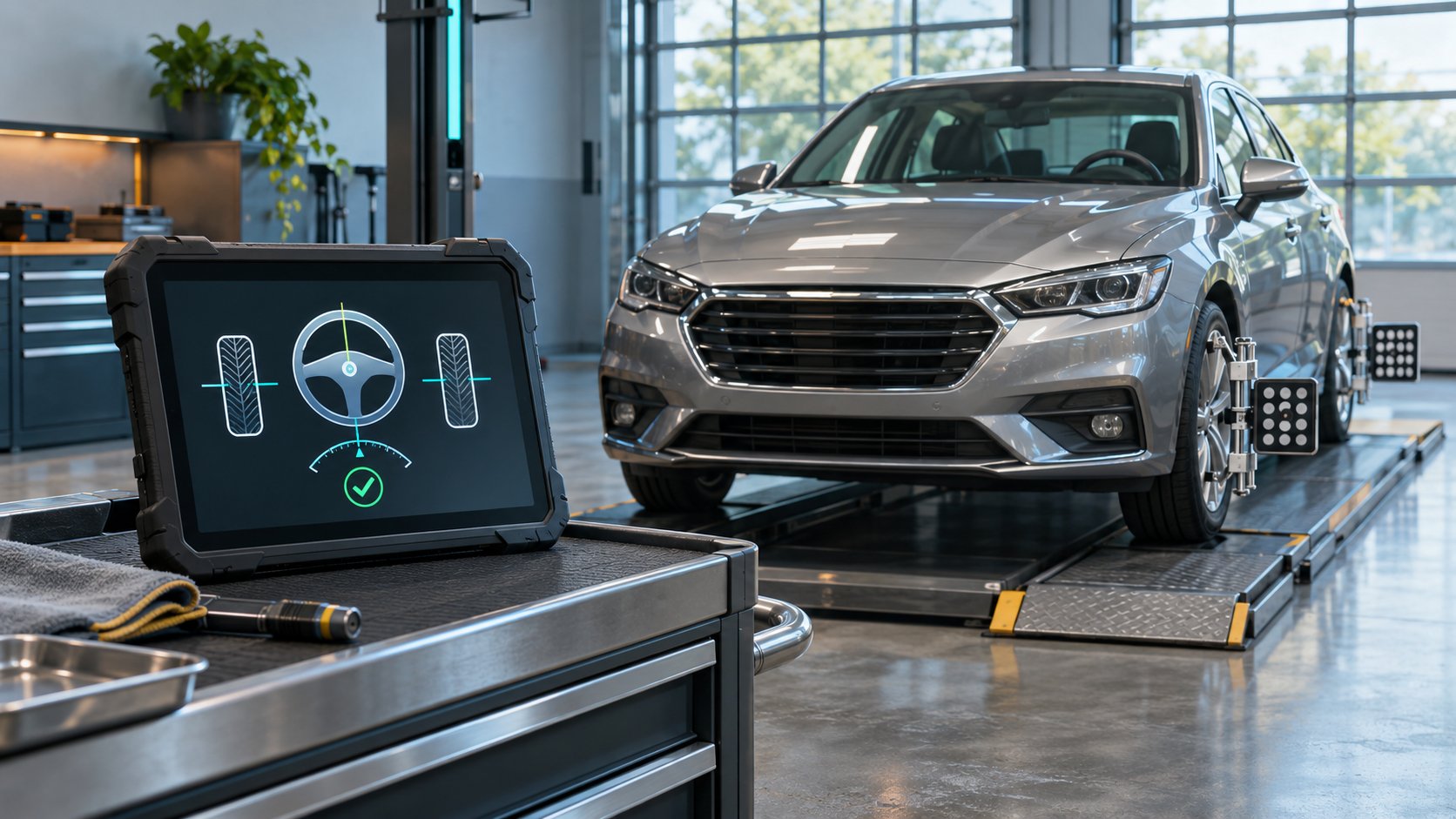
A steering wheel can look centered while the vehicle’s control modules report a small left or right turn. That mismatch matters because stability control, electric power steering and some driver-assistance functions use steering-angle data to compare the driver’s intended direction with the vehicle’s actual movement.
Steering angle sensor calibration teaches the relevant control unit the correct straight-ahead reference after specified alignment, steering or suspension work. It is also called SAS reset, zero-point calibration, neutral-position learning or initialization. The names vary, and so do the triggers and completion steps. A scan tool can store the reference, but it cannot make a mechanically misaligned vehicle straight.
What the steering angle sensor measures
The steering angle sensor detects the steering wheel’s position and direction of rotation. Many systems also calculate rotation speed and the number of turns from center. The sensor may be part of the clockspring, steering-column electronics or electric power-steering assembly rather than a separate component.
Electronic stability control compares this signal with wheel speed, yaw rate and lateral acceleration. If the vehicle does not follow the path requested by the steering input, the system can intervene within its programmed limits. Steering-angle information may also support parking assistance, adaptive lighting and advanced driver-assistance functions. HELLA’s steering-angle sensor overview notes that workshop professionals must account for sensor zeroing after chassis measurement and adjustment work.
Calibration is not wheel alignment
Wheel alignment sets physical geometry such as toe, camber and caster where the vehicle permits adjustment. SAS calibration stores or learns an electronic reference that tells a control unit what “straight ahead” means. These operations support each other but are not interchangeable.
If the steering wheel is off-center because toe is incorrect, a calibration may hide the symptom temporarily or fail, but it does not correct the geometry. Conversely, a properly aligned vehicle can still have a warning lamp or incorrect steering-angle value if the electronic zero point was not learned after a required repair.
A Stellantis service case in the NHTSA technical archive describes an invalid steering-angle signal after steering-column work and alignment. It instructs technicians to validate alignment and steering-wheel centering before attempting calibration. That order prevents an electronic reset from being used to mask a mechanical offset.
When SAS reset may be required
The vehicle manufacturer’s workshop information is the deciding source. Depending on the model and system, calibration may be specified after:
- steering angle sensor, clockspring or steering-column replacement;
- steering wheel, steering gear, rack, tie-rod or linkage work;
- wheel alignment or track adjustment;
- suspension or chassis work that changes steering geometry;
- an accident affecting the steering or sensor assembly;
- control-module replacement, coding or software work; or
- a relevant fault code or incorrect live-data value after repairs.
These are possible triggers, not a claim that every alignment needs a scan-tool reset. A Bendix steering-angle calibration document for its advanced ABS system requires diagnostic recalibration after sensor, connector-hub, linkage, steering-gear and alignment work. Porsche service information likewise calls for steering-angle calibration after correcting alignment values on the covered vehicles. Other designs may self-learn during a specified drive or require calibration only after particular operations.
What a reliable calibration workflow looks like
- Confirm the trigger and procedure. Identify the exact vehicle, control system and manufacturer-required function.
- Fix mechanical and electrical faults first. Check steering and suspension components, tire condition and pressure, alignment, wiring, power supply and relevant DTCs.
- Prepare the vehicle correctly. Many procedures require a level surface, straight road wheels, centered steering wheel and stable battery voltage. Some add engine, brake-pedal or drive-cycle conditions.
- Read the live angle. Compare the reported value with the physical straight-ahead position and look for erratic data that could indicate a sensor or wiring fault.
- Run the exact guided function. Use the menu for neutral learning, zero point or calibration rather than assuming a similarly named reset is equivalent.
- Verify completion. Recheck live data and fault memory, follow any specified steering movement or road test, and confirm that warning lamps and related systems operate normally.
Mitsubishi instructions for covered stability-control systems call for neutral-position learning after front alignment adjustment or steering-wheel-sensor service, with the tires and steering wheel straight ahead. The document also requires relevant faults to be addressed. This illustrates why prerequisites are part of the calibration, not optional preparation.
Why calibration can fail
A failed or repeatedly lost calibration may indicate more than a software issue. Common causes include a steering wheel installed off-center, incorrect alignment, a clockspring or sensor outside its mechanical center, damaged wiring, low voltage, unresolved ABS or steering faults, unsupported scan-tool coverage, or a procedure performed on an unsuitable surface.
Do not repeatedly write a new zero point until a warning lamp disappears. Review live steering angle while turning smoothly in both directions, compare side-to-side travel where the manufacturer specifies it, and diagnose implausible or jumping values. Safety systems should be verified before the vehicle returns to service.
Choosing a scanner for steering-angle calibration
Current SpeedXperts listings advertise SAS or steering-angle service functions on several in-stock tools. The wireless XTOOL A30D V2.0 provides full-system diagnostics and active tests through a phone or tablet. The XTOOL D7 V2.0 og XTOOL D7S V2.0 are dedicated workshop tablets with broader service-function menus.
A generic “SAS reset” icon does not guarantee the correct routine for every model year, steering system or control-unit version. Confirm application coverage and the exact function before purchase or repair. More options are available in the kategorien »diagnostiske værktøjer«. Our guide to service functions versus active tests explains why guided calibration is different from simply commanding a component.
Ofte stillede spørgsmål
Does every wheel alignment require SAS calibration?
No. Requirements vary by vehicle and by the adjustments performed. Follow the current workshop procedure rather than applying a universal rule.
Can calibration fix an off-center steering wheel?
It cannot correct mechanical alignment, incorrect steering-wheel installation or worn parts. Those conditions must be repaired before the electronic reference is learned.
Is clearing the SAS fault code the same as calibration?
No. Clearing a code removes the stored record. Calibration teaches a reference value, and it should only be completed after the underlying fault and prerequisites are addressed.
Can the sensor calibrate itself while driving?
Some vehicles use a manufacturer-defined drive or steering sequence, while others require a scan-tool routine. Use the procedure for the exact vehicle.