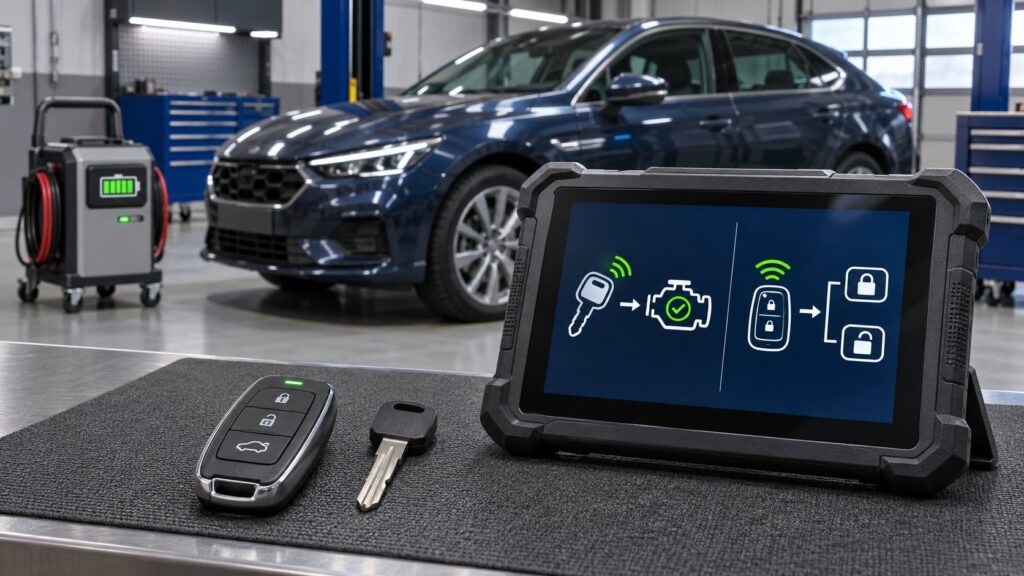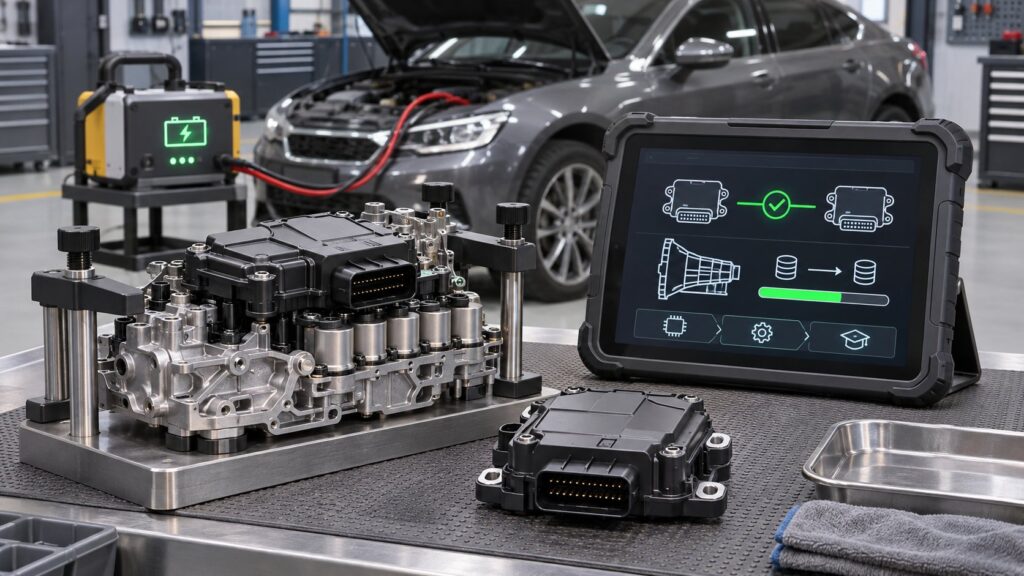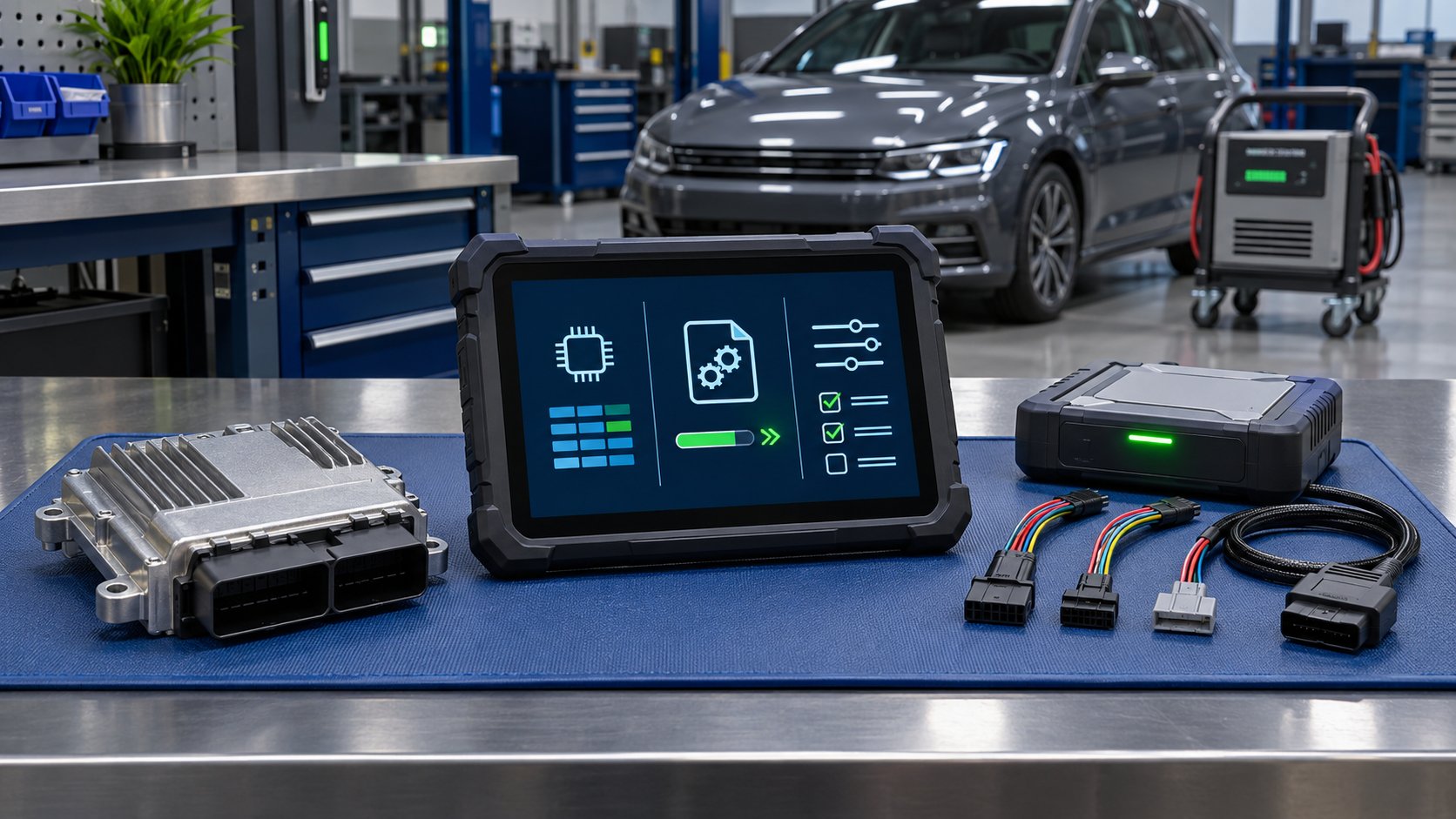
EEPROM programming vs ECU coding compares two operations that are often grouped under the word “programming” even though they work at different levels. EEPROM work reads or writes nonvolatile memory data. ECU coding selects supported configuration options for a specific vehicle. Software flashing is a third operation: it installs executable software or calibration into a controller.
Confusing these jobs can lead to the wrong tool, the wrong file or an incomplete module replacement. The correct method depends on the exact controller, vehicle identification number, part number and repair goal. Always use the manufacturer’s service procedure and preserve the original data before any authorized write operation.
Four operations that should not be treated as synonyms
| Operation | Main purpose | Typical access |
|---|---|---|
| ECU coding or configuration | Selects supported vehicle equipment, regional settings or controller behavior | Diagnostic connection and guided software |
| Software reprogramming | Replaces or updates executable software and calibration | OEM application through a diagnostic or pass-through interface |
| Blank-module programming | Initializes a compatible replacement controller with approved software and identity data | OEM replacement workflow |
| EEPROM read or write | Accesses persistent data stored in a nonvolatile memory area or device | Vehicle-specific diagnostic method, bench connection or controlled electronics work |
Nissan’s CONSULT service bulletin NTB21-041B shows these distinctions in a real OEM interface. Its operation screen separates reprogramming, programming a blank ECU and vehicle configuration. That structure is a useful reminder that a tool menu label describes a specific workflow, not a universal way to alter every kind of module data.
What EEPROM programming changes
EEPROM stands for electrically erasable programmable read-only memory. Despite the historic name, it can retain information without continuous power and can be erased and written under controlled conditions. Automotive controllers may use nonvolatile memory for configuration values, learned references, production information, counters or other persistent data. The content and layout are specific to the controller and software version.
Microchip’s automotive serial EEPROM overview explains that data remains stored without continuous power and that programming occurs through an internal write cycle. Its EEPROM endurance guidance also treats write-cycle endurance as a defined device characteristic. That is one reason indiscriminate repeated writing is poor practice.
An EEPROM backup is not interchangeable with an OEM calibration file. A raw memory read may include controller-specific data but does not necessarily contain the main operating software. Likewise, a successful flash update does not prove that every persistent configuration value is correct.
What ECU coding changes
ECU coding or configuration tells a supported controller how the vehicle is equipped or which approved options should be active. Examples can include body style, installed equipment, market settings or network configuration. Coding normally works through defined parameters exposed by the diagnostic application rather than by manually editing memory addresses.
An Infiniti module-replacement bulletin instructs technicians to record configuration items and their setting values, then use the separate “After ECU Replacement” configuration operation. That process transfers known vehicle specifications; it is not presented as the same task as software reprogramming or blank-module programming.
Software flashing is a third layer
Flashing installs approved program code or calibration into flash memory. It may correct a documented software issue or prepare a new module, but it does not repair damaged hardware, wiring faults or an incompatible part. Some replacement workflows combine flashing, configuration, identity setup and relearning in sequence, which is why the complete service procedure matters.
Onze KESS vs K-TAG guide explains common access methods for ECU reading and writing. Those terms describe how communication reaches a controller; they do not by themselves identify whether the operation changes flash, EEPROM or configuration data.
A safe workflow before changing module data
- Define the repair goal. Decide whether the job is a documented software update, replacement-module setup, configuration correction or recovery of known original data.
- Diagnose the vehicle first. Record fault codes, module identification, software numbers and network condition. Programming cannot compensate for low voltage, a communication fault or incompatible hardware.
- Confirm the exact controller. Match the VIN, part number, hardware version and applicable supersession. Similar housings and connectors do not prove compatibility.
- Follow the OEM path. Use the specified reprogramming, blank-module or configuration operation. Do not substitute a raw memory write merely because a file is available.
- Preserve original information. Save supported backups, configuration reports and identification screenshots before changing data. Keep them labeled to the vehicle and module.
- Stabilize electrical power. Use the approved support equipment and required voltage range. Secure diagnostic and bench connections, disable unnecessary loads and avoid interrupting a write.
- Verify the result. Confirm software and part numbers, configuration, fault status and every required relearn. Document what changed and retain the original report.
What these operations cannot fix
Neither coding nor EEPROM writing repairs water damage, broken solder joints, shorted drivers or unstable vehicle power. They also cannot make an incompatible controller fully equivalent to the correct part. If a write repeatedly fails, stop and diagnose voltage, communication, file selection and hardware condition instead of retrying until the module becomes unresponsive.
Some stored data is regulated or security-sensitive. Odometer, immobilizer, emissions and safety-system work must follow ownership, legal and manufacturer requirements. This article explains categories of work; it does not provide memory addresses, security-data editing or bypass procedures.
Choosing the appropriate equipment
The current XTOOL D7 V2.0 listing includes ECU coding and EEPROM-related functions. The XTOOL X100PADS V2.0 en Carprog V13.77 listings also describe EEPROM capabilities. Coverage and access method vary by controller, vehicle, software and adapters, so confirm the exact function before purchase or use. Compare other equipment in the categorie ‘diagnostische hulpmiddelen’.
EEPROM and ECU coding FAQ
Is coding the same as flashing?
No. Coding selects supported configuration, while flashing installs software or calibration. An OEM replacement procedure may require both.
Does an EEPROM backup contain the whole ECU program?
Not necessarily. Controllers can store program code, calibration and persistent data in different memory areas or devices.
Should a used module be copied from the original?
Only when the OEM procedure, compatibility and applicable rules support that repair. A data copy cannot correct incompatible hardware or unknown damage.
Understanding EEPROM programming vs ECU coding helps match the repair to the correct data layer. Identify the module and goal, use the manufacturer’s workflow, preserve original information, maintain stable power and verify the entire vehicle after the change.