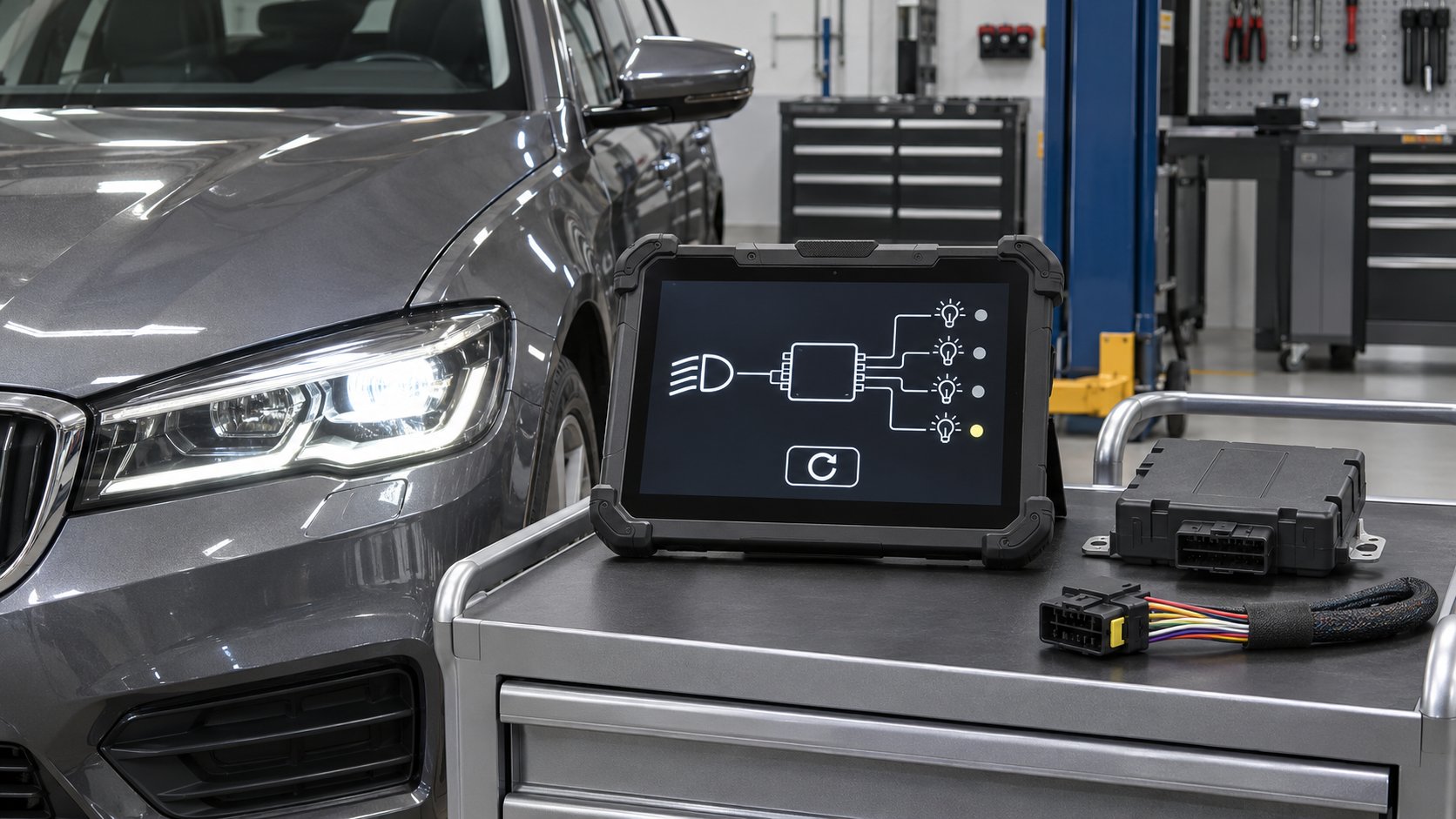
A BMW FRM reset is sometimes needed when the Footwell Module has recorded a lighting short circuit and disabled an affected output. The reset can clear the relevant counter or release an electronically protected circuit after the real fault is diagnosed. It cannot repair a damaged lamp, corroded connector, pinched wire or failed control module.
That distinction prevents a common mistake: treating “FRM Reset” as a universal button for every lighting problem. BMW and MINI procedures depend on the model, module generation, stored fault and test plan. Diagnose the vehicle first, then use the exact service function specified for it.
What the Footwell Module does
On applicable BMW and MINI vehicles, the FRM manages body functions that can include exterior and interior lighting, power windows and related status messages. Its electronic lighting outputs monitor current so the module can recognize an open circuit or short circuit. Depending on the system and fault history, it may switch an output off to protect the circuit.
Symptoms can therefore look wider than a failed bulb. One lamp may remain inoperative after a repair, a check-control message may persist, or several body functions may stop together. A BMW service bulletin for selected F-series vehicles shows another reason to avoid assumptions: wipers, lights and front windows could fail because a power-distribution connector was not fully seated. Its procedure directs technicians through vehicle diagnosis and an FRM supply test plan rather than replacing or resetting parts blindly.
What an FRM reset actually changes
A short-circuit counter records fault-related events for a protected output. On a supported application, the reset procedure can clear or restore the relevant logic so diagnosis continues and the repaired output can operate again. It does not remove the electrical cause of the event.
A 2026 MINI service bulletin for FRM fault 9CBB makes this explicit. After the counters are reset, technicians must still perform vehicle diagnosis and a visual check to find the pre-existing short-circuit causes. If those faults remain, the counters begin accumulating data again and the module may sustain permanent damage. The bulletin’s special adapter sequence is specific to the listed vehicles and conditions; it is not a generic instruction for every FRM.
Reset, coding and module repair are different
| Operation | Purpose | What it cannot do |
|---|---|---|
| FRM reset | Clears supported short-circuit counters or restores a protected output after the fault is addressed | Repair wiring, bulbs, lamp electronics or internal module damage |
| Coding | Configures a compatible module for the vehicle and installed equipment | Recover every unresponsive or electrically damaged module |
| Programming | Loads approved software as part of an OEM-directed repair | Correct missing power, ground or communication wiring |
| Module recovery or repair | Addresses a module that no longer communicates or has corrupted/internal faults | Replace diagnosis of the circuit that caused the failure |
BMW’s FRM warranty bulletin describes replacement followed by vehicle programming and encoding when a module has failed. The 2026 MINI bulletin likewise says replacement and vehicle programming may be required when the FRM cannot be reset. That is a different job from clearing a supported lighting counter.
When to consider the service function
An FRM reset may be appropriate when all of the following are true:
- the exact vehicle uses an FRM and the diagnostic session communicates with it;
- fault codes or the OEM test plan identify a protected lighting output or short-circuit counter;
- the bulb, lamp assembly, wiring, connector, power and ground have been tested;
- the short circuit, moisture intrusion, damaged insulation or incorrect component has been repaired; and
- the manufacturer’s procedure calls for a reset or output reactivation.
Do not use the function merely because a headlamp is low or points in the wrong direction. Aim and ride-height reference problems belong to a different workflow; see our headlight level sensor calibration guide.
A practical diagnostic workflow
- Verify the complaint. Record which lamps and body functions fail, whether the problem is intermittent, and whether recent bulb, lamp, battery, collision or wiring work preceded it.
- Run a complete vehicle scan. Save FRM, instrument-cluster and communication faults before clearing codes. Confirm the exact module identification and software state.
- Inspect the circuit. Check the correct bulb or LED unit, fuse information, connector pins, grounds, harness routing and signs of water or heat. Use the wiring diagram for the VIN.
- Follow the linked OEM test plan. A counter value alone does not prove which component caused the short. Complete the voltage, resistance or visual checks specified for that circuit.
- Repair the root cause. Replace or repair only what testing confirms. Do not repeatedly reactivate a circuit that still draws abnormal current.
- Stabilize voltage. Use the approved battery support for diagnosis, coding or programming. Low voltage can interrupt communication and create additional faults.
- Run the correct reset. Select the vehicle-specific function, read every prompt and save the completion result.
- Verify every affected function. Rescan, operate the lighting in each required mode, check for returning codes and confirm that road-legal lamps work before releasing the vehicle.
Choosing a diagnostic tool
A basic OBD2 reader usually accesses emissions data, not BMW body-module service functions. The scanner must communicate with the installed FRM and support the required reset on that exact chassis and software version. “Full system,” “coding” and “bidirectional” do not by themselves prove coverage; our active-tests and service-functions guide explains the difference.
Current SpeedXperts listings for the XTOOL X100PADS V2.0 and XTOOL D7 V2.0 explicitly include FRM Reset among their service functions. Coverage varies by vehicle, so confirm the model, year, chassis and intended operation before buying. Compare other equipment in the diagnostic-tools category.
FRM reset FAQ
Will an FRM reset fix a dead headlamp?
Only if a supported protected output remains disabled after its underlying circuit fault has been repaired. It will not fix a failed bulb, LED driver, ballast, connector, ground or harness.
Can a reset revive an FRM that does not communicate?
Not reliably. First verify power, ground and network communication. An unresponsive module may require an OEM recovery process, specialist repair or replacement followed by programming and encoding.
Should the counter be cleared before repairing the short?
Follow the exact OEM procedure. Some current MINI instructions use a special preventive reset sequence before further diagnosis in defined conditions. That specific sequence should not be generalized to other vehicles or tools.
The dependable approach is simple: identify the FRM and fault, test the affected circuit, repair the electrical cause, then perform the prescribed reset and final lighting check. A successful reset confirms that the module accepted a command; it does not replace proof that the circuit is safe and functional.