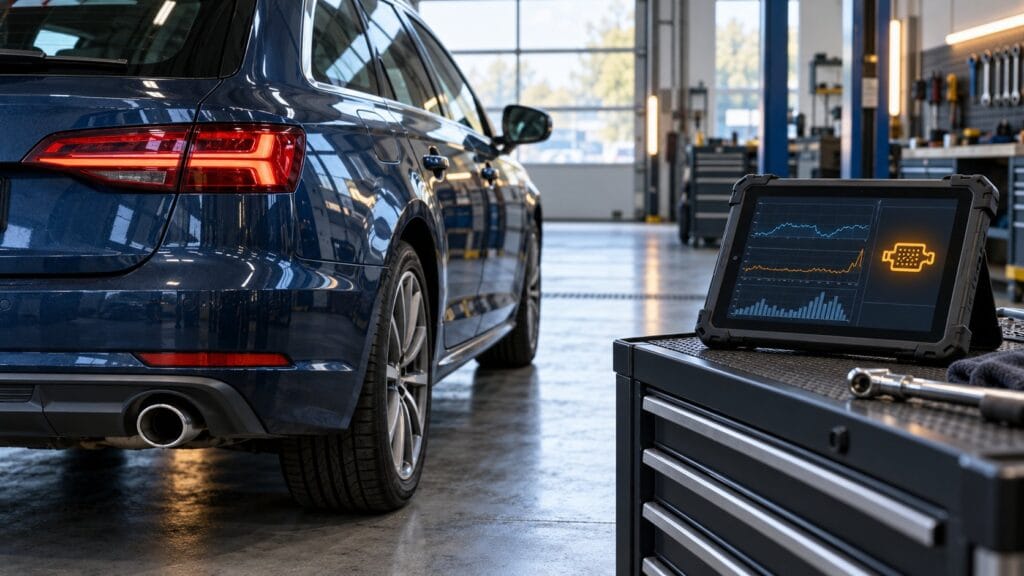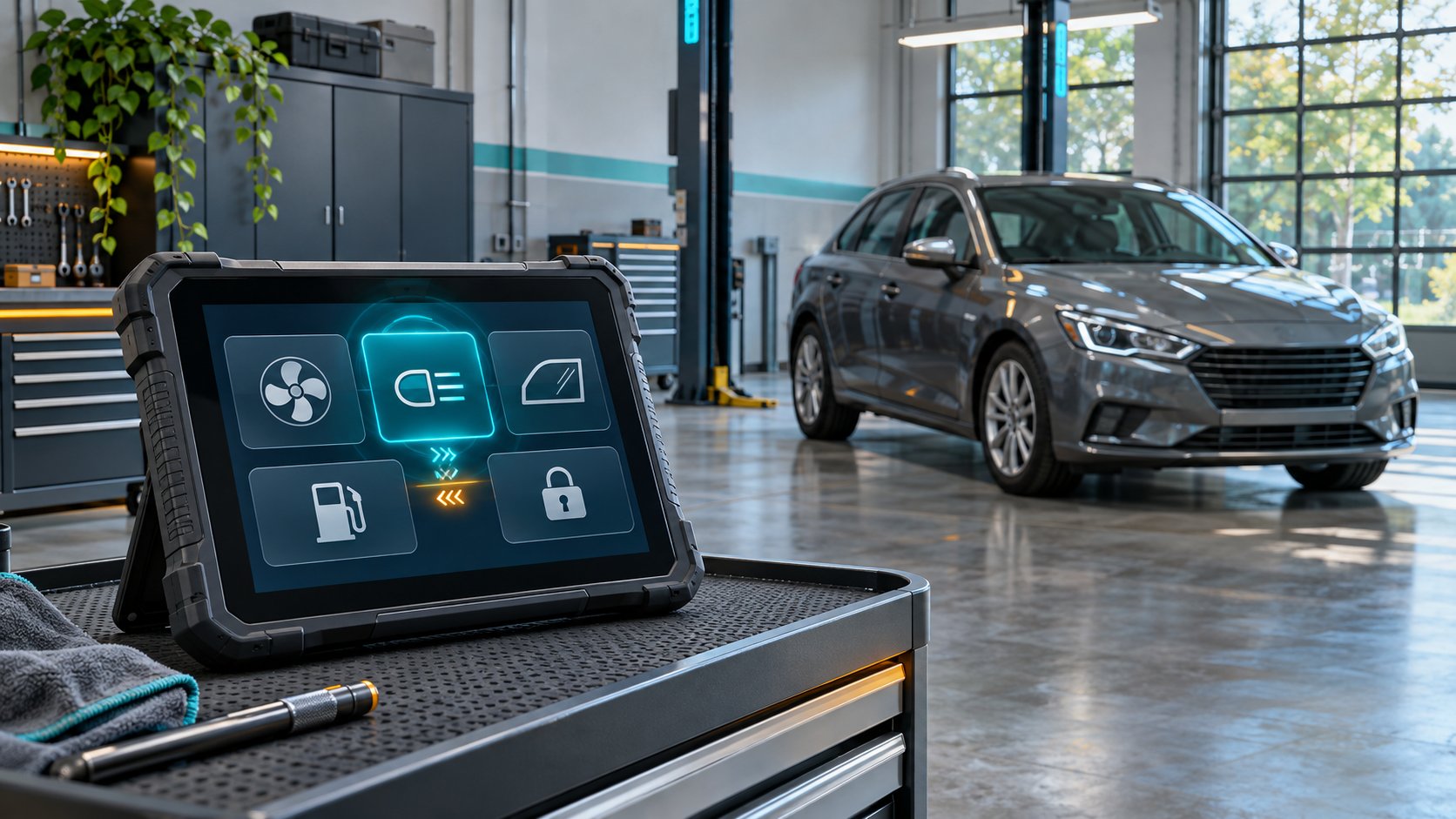
A scan tool can read a fault code without proving whether a component can respond to a command. A bidirectional tool adds that next step: it can request a supported control unit to operate an actuator while the technician observes the result. This is often called an active test, actuation test or output control.
A bidirectional scan tool can shorten diagnosis, but the label is frequently confused with service resets, coding and programming. Those functions are related only because they share the same diagnostic interface. Their purpose, prerequisites and risks are different, and availability always depends on the exact vehicle and module.
What bidirectional control means
During an active test, the scanner sends a command to a control unit and the control unit attempts to operate the selected output. A technician might command a lamp, door lock, window, wiper, cooling fan or fuel pump on a supported vehicle. XTOOL’s official A30D page describes bidirectional control in these terms and lists those components as examples.
“Bidirectional” does not mean unrestricted control. The vehicle ECU decides whether a request is supported and whether current conditions permit it. Ignition state, engine status, battery voltage, gear position, temperature, security access and other prerequisites can affect the result. The scan tool’s coverage database must also contain that exact test.
Active tests vs live data, service functions and coding
| Function | What it does | Typical diagnostic purpose |
|---|---|---|
| Live data | Displays values and states reported by a module | Observe what the vehicle sees while operating |
| Active test | Commands a supported output or operating state | Check whether the module and component respond |
| Service function | Runs a guided reset, relearn, calibration or maintenance routine | Complete a specified repair or maintenance task |
| Coding or configuration | Changes supported module settings or identifies a replacement | Configure equipment or match a module |
| Programming | Writes software or calibration data | Update or replace module software |
Bosch’s ADS 10X Plus description lists bidirectional tests separately from calibrations, resets and relearns. That distinction matters when comparing products. A tool with many oil, brake and battery resets is not necessarily capable of commanding vehicle actuators, while an active-test tool may still lack a particular relearn or coding function.
How an active test helps diagnosis
Separate commands from automatic operation
Suppose a cooling fan does not run when expected. Live data can show temperature and requested fan state; an active test can ask the controller to operate the fan under the manufacturer’s test conditions. If it responds, the result helps separate the output path from the sensors and logic that normally request operation. If it does not, the technician still needs the wiring diagram and test plan to distinguish a blocked command, power or ground fault, control-circuit issue, mechanical failure or unsupported test.
Test components without unnecessary removal
Commanding a supported lock, lamp or valve can confirm visible or audible movement before parts are removed. That can save time and reduce speculative replacement. However, one successful movement does not prove that a component works correctly under every load, temperature or duty cycle. An intermittent fault can also pass a short test.
Compare command, feedback and physical response
The strongest result combines three observations: what the scanner commanded, what the module reported and what the component actually did. A status PID may change even when a mechanical part remains stuck. Conversely, a component may operate while a feedback sensor reports an implausible position. Use the service manual’s expected result rather than treating “test completed” as a diagnosis.
Safety before commanding an actuator
Active tests can start motors, pumps, fans and other moving or pressurized systems. Clear the work area, secure the vehicle, follow the on-screen and OEM warnings, and keep people, tools and clothing away from anything that can move. Never run a test merely to see what it does.
A Triumph safety-recall procedure published through NHTSA’s document archive uses a diagnostic function test to command a cooling fan and specifically warns that the fan can operate automatically and that hands and clothing must remain clear. It is a useful example of why an active test belongs inside a vehicle-specific procedure, not a generic list of buttons to press.
- Scan first. Save all DTCs, freeze-frame information and relevant live data before clearing anything.
- Read the test description. Confirm the component, prerequisites, expected response and stop conditions for the exact vehicle.
- Prepare the vehicle. Use the specified ignition state and power support, secure the vehicle and clear the component’s operating area.
- Observe rather than assume. Compare the physical response with feedback PIDs and the service-manual specification.
- End and rescan. Stop the command, return the vehicle to its normal state and check for new or returning codes.
Why a supported test may still be unavailable
Coverage can vary between engines, trim levels, markets and software versions within one model year. A menu may be absent because the module does not expose the function, the scanner software lacks that application or the vehicle conditions are not met. A secure gateway can also restrict commands.
Only authorized tools can perform protected tests on some gateway-equipped vehicles. Bosch’s secure-gateway guidance specifically includes bidirectional tests among functions that may require authenticated access. Gateway support, network support such as CAN FD and the active-test database are separate buying checks.
Current SpeedXperts bidirectional-tool examples
The in-stock XTOOL A30D V2.0 listing advertises full-system diagnostics, active tests and a separate set of service functions in a Bluetooth format. It gives examples such as fuel-pump, cooling-fan, lock and window commands, while stating that function availability depends on make, model and year.
The in-stock XTOOL D7 V2.0 listing adds a dedicated tablet, active tests, broader service functions and selected ECU coding. That makes it a different workflow, not evidence that every listed function exists on every vehicle. Compare the exact coverage and update model before choosing.
Browse the Kategorie „SpeedXperts-Diagnosetools“ for alternatives. The CAN FD scanner guide explains why communication hardware and secure access must also match the vehicle.
Bidirectional scan tool FAQ
Does bidirectional mean full-system?
No. A tool can offer active tests on selected systems without covering every module. Verify the exact system and command in the current coverage information.
Is an active test the same as an actuator relearn?
No. An active test commands an output for diagnosis. A relearn or calibration is a service routine that stores or adapts values according to a specified procedure.
Can an active test prove a part is good?
It can confirm a response under the test conditions, but diagnosis still depends on feedback, wiring, load and the service specification. Passing one command does not rule out intermittent or performance faults.
The value of bidirectional control is focused evidence. Choose a tool by the commands available for the vehicles you service, then use each command within the manufacturer’s test plan and safety conditions.