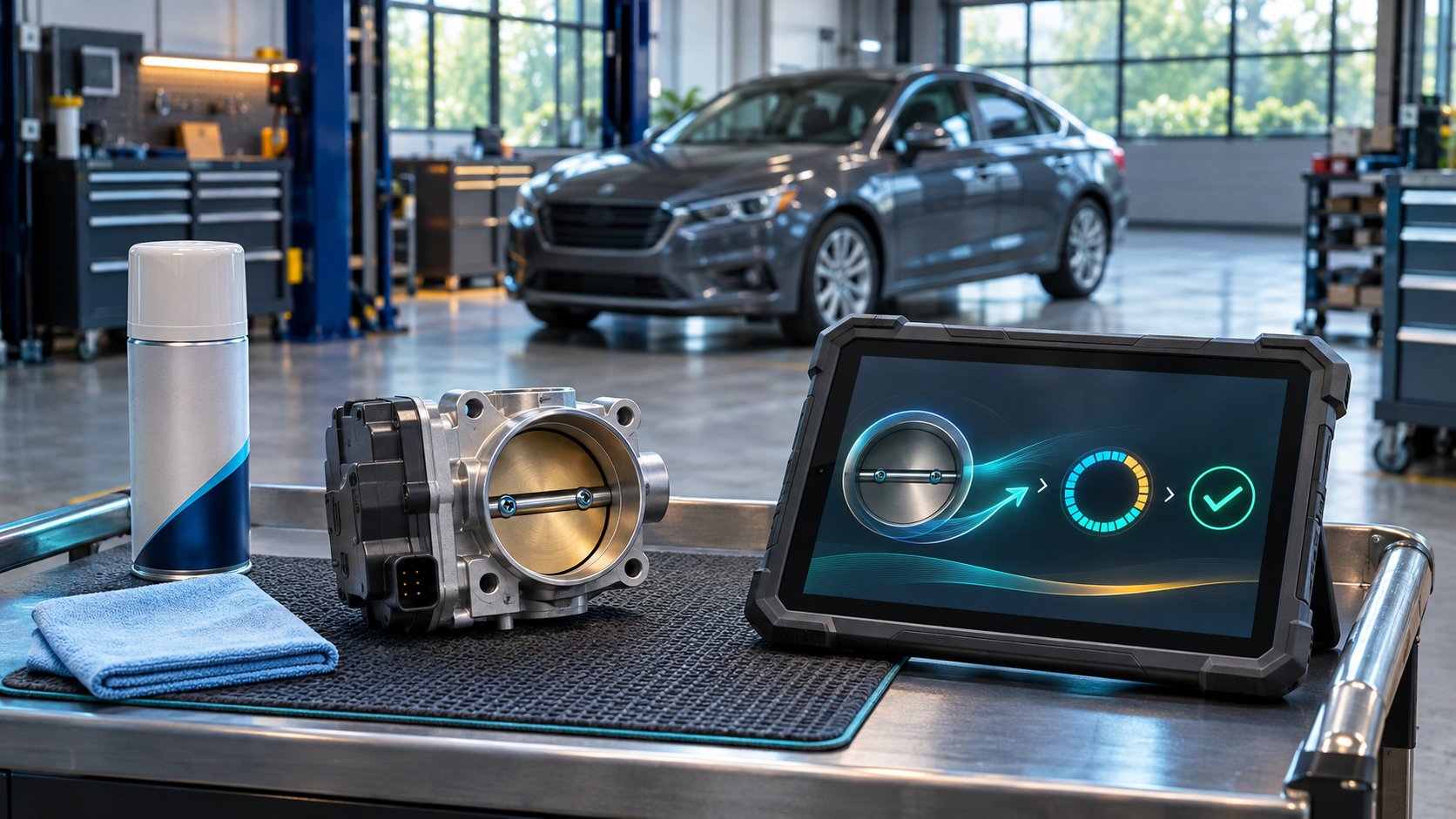
A vehicle may idle too high, stall, hesitate or set a throttle-related fault after the throttle body has been cleaned or replaced. The repair may be mechanically correct, yet the engine control module can still be using learned airflow values that no longer match the air passing the throttle plate.
A throttle body relearn allows the control system to establish the reference or compensation values required by that application. It may be called idle learn, throttle adaptation, minimum-position learn, airflow compensation reset or electronic throttle control relearn. Some vehicles need a scan tool, others use a specified key, idle or drive sequence, and some learn automatically. The correct method must come from current service information.
What the engine control module learns
In an electronic throttle system, the accelerator pedal is a sensor input rather than a direct cable connection. The engine control module commands an electric motor in the throttle body and compares multiple position signals to confirm that the plate moved as expected.
The module may also learn how much air passes the throttle at or near its closed position. Deposits, component tolerances and normal wear can change that relationship over time. The learned value helps the system control idle speed and compensate for accessories and operating conditions. Cleaning away deposits or fitting a different throttle body can change actual airflow while the module still holds the old correction.
An Isuzu Throttle Learn Reset document explains that its ECM stores throttle-body airflow values and requires relearning when airflow changes after cleaning or replacement, or when the ECM is replaced or reprogrammed. That requirement applies to the covered system; it should not be treated as a universal rule for every vehicle.
When a throttle relearn may be needed
Depending on the manufacturer and powertrain, service information may specify relearn after:
- cleaning carbon deposits from the throttle bore or plate;
- removing or replacing the electronic throttle body;
- replacing, programming or resetting the engine control module;
- disconnecting power long enough to erase learned values;
- repairing an intake-air fault that caused incorrect compensation; or
- setting a minimum-position or idle-learning DTC after repair.
Not every cleaning job requires a manual reset, and battery disconnection does not produce the same behavior on every model. A Stellantis throttle-body replacement bulletin specifically warns that the required electronic throttle control relearn must be completed after replacement on the covered vehicles. Other systems may perform part of the learning during ignition shutdown, warm idle or a defined drive cycle.
Relearn does not repair the cause of a bad idle
A reset should follow diagnosis, not replace it. If unmetered air enters through a split intake hose, loose clamp, failed gasket, PCV fault or disconnected vacuum line, the engine may continue to idle badly regardless of how often learned values are cleared. The same applies to wiring faults, a sticking throttle plate, incorrect parts, low voltage, contaminated sensors or unresolved DTCs.
GM service information in the NHTSA technical archive describes how an induction-system air leak or engine mechanical problem can cause incorrect idle-airflow compensation to be learned. Its repair sequence addresses the mechanical problem first, then calls for inspection, cleaning, idle relearn and airflow compensation reset on the covered application.
Cleaning and fault clearing are separate operations
Cleaning removes deposits from approved surfaces using the product and method specified by the manufacturer. Relearn changes stored control values. Clearing a fault code only removes the diagnostic record after the underlying condition is repaired. These steps can appear in one job, but none substitutes for the others.
Electronic throttle bodies contain a motor, gears and position sensors. Do not soak electronic components, spray cleaner into connectors or force a motorized plate unless the vehicle or component instructions explicitly permit that action. Use eye and skin protection, work away from ignition sources, and allow approved cleaner to evaporate as directed before reassembly.
A reliable workflow before starting relearn
- Identify the exact system. Use the VIN, engine code and current service procedure to determine whether relearn is required and which method applies.
- Scan before resetting. Record DTCs, freeze-frame data and relevant live values. Diagnose actuator, pedal, airflow and voltage faults first.
- Inspect the air path. Confirm that ducts, clamps, gaskets, PCV connections and vacuum hoses are sealed and correctly installed.
- Verify the component and repair. Make sure the throttle body is correct, clean, undamaged and electrically connected.
- Meet all prerequisites. Procedures can specify battery voltage, coolant temperature, accessory state, transmission position, pedal release and a fault-free module.
- Run the stated learn process. Follow the scan-tool prompts or manufacturer-defined ignition, idle and drive sequence without adding generic steps.
- Confirm the result. Recheck idle stability, commanded and actual throttle data, fault memory and any completion status provided by the tool.
When is a scan tool needed?
A scan tool is needed when the manufacturer requires a reset or guided learn command, when a completion status must be monitored, or when diagnosis requires throttle and airflow live data. A basic emissions code reader may clear an engine code but usually cannot access manufacturer-specific adaptation functions.
Some vehicles complete learning without a dedicated command. Even then, a capable tool remains useful for confirming prerequisites and results. Do not assume that a menu labelled “Throttle Reset” supports every engine; application coverage can differ by model year, engine, region and control-module software.
Choosing a scanner with throttle service support
Current SpeedXperts listings advertise throttle-related service functions on several in-stock scanners. The compact XTOOL D5S covers five major systems and selected maintenance functions. The XTOOL D7 V2.0 und XTOOL D7S V2.0 provide broader workshop-oriented diagnostics and service menus.
Confirm the exact throttle adaptation or relearn function for the target vehicle before purchase. You can compare additional equipment in the Kategorie „Diagnosewerkzeuge“. If the warning lamp remains on, our check-engine-light diagnostic guide explains why code data should be preserved before clearing it.
Häufig gestellte Fragen
Does cleaning a throttle body always require relearn?
No. Requirements vary by vehicle and by how much the learned airflow relationship changed. Follow the manufacturer’s procedure for the exact engine.
Can disconnecting the battery perform the reset?
Sometimes power loss clears certain learned values, but it is not a universal or controlled substitute for the specified procedure. It may also erase unrelated settings.
Will relearn fix a vacuum leak?
No. Air leaks and mechanical or electrical faults must be repaired first. Otherwise, the module may learn another incorrect compensation value or the routine may fail.
Is throttle relearn the same as clearing codes?
No. Clearing codes removes stored diagnostic information. Relearn establishes control values needed for the repaired system.