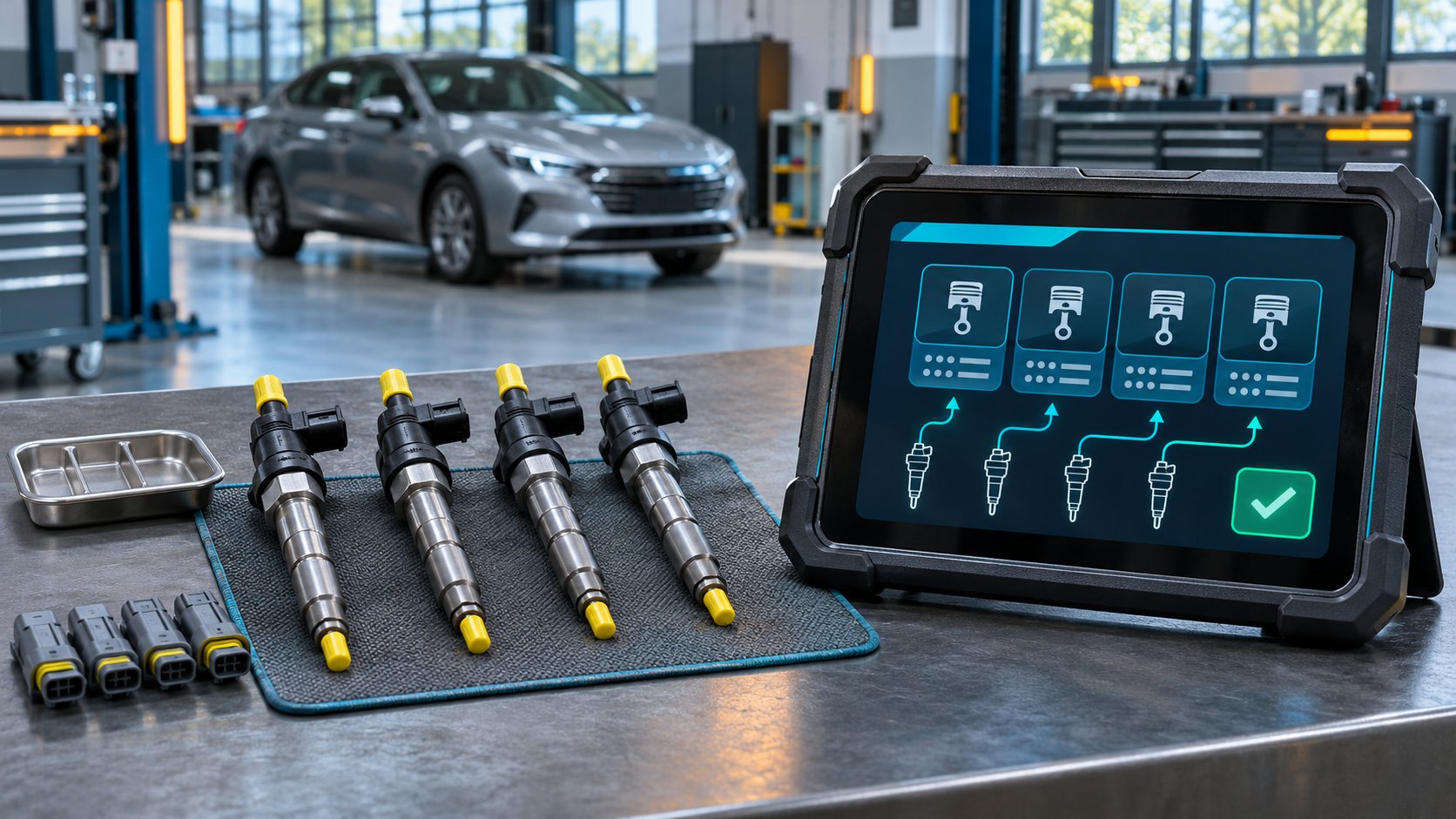
Injector coding after replacement stores the individual calibration or correction code for a fuel injector in the engine control module. On systems that require it, the code helps the module compensate for small manufacturing differences between injectors. The code must belong to the installed injector and be assigned to its actual cylinder.
Coding is only one part of the repair. It cannot correct a leaking injector, excessive return flow, low compression, contaminated fuel, incorrect rail pressure or a wiring fault. Some engines also require a separate adaptation or drive routine; others do not require injector coding at all. Always use the current procedure for the exact VIN, engine and injector part.
What is an injector calibration code?
During production, certain common-rail diesel and gasoline injectors are measured for delivery behavior. A code marked on the injector represents its individual correction data. Manufacturers use different names and formats, including injector quantity adjustment, trim code, compensation code, classification code, IMA/ISA, C2I or C3I. These terms are not universally interchangeable.
The engine controller associates that value with a cylinder so it can refine injection quantity or timing within the system’s design. A Stellantis recall procedure, for example, instructs technicians to enter a seven-character alphanumeric code beside the cylinder that matches the injector’s physical installation location. That exact format applies to the covered repair, not every vehicle.
Coding, adaptation and diagnosis are different jobs
Codage des injecteurs
Coding records the injector’s printed or electronically supplied correction value in the correct cylinder field. A Mack Trucks bulletin states that the new trim codes printed on the injector connector must be programmed into the ECM after the specified injector and ECM work. It links correct data with engine timing and emissions on those engines.
Adaptation or teach-in
Adaptation is a separate learning process based on engine operation. Terms such as zero-quantity adaptation, pilot injection learn or smooth-running correction describe different strategies. A vehicle may require code entry, an adaptation routine, both, or neither. Do not clear learned values merely because a scan tool offers the option.
Injector diagnosis
Balance values, cylinder cut-out, leak-off or return-flow testing, electrical checks and compression testing help identify a fault. They do not write an injector code. Likewise, entering the correct code does not prove the injector is mechanically sound.
Mercedes-Benz guidance for a covered zero-quantity calibration concern directs technicians to compare the codes stored in the control unit with those printed on the injectors and to check smooth-running corrections. When the specified checks show no issue, it says not to replace hardware or reset the injector codes simply as a guess.
When can injector coding be required?
- after installing a new or remanufactured injector that carries a unique code;
- after moving coded injectors between cylinders;
- after engine control module replacement or programming when the OEM procedure requires re-entry or verification;
- when diagnosis confirms that the stored value does not match the physical injector; or
- after a specified engine, cylinder-head or fuel-system repair that includes injector classification.
Do not assume every replacement injector needs manual coding. Some parts are classified differently, some modules obtain information through another process, and some engines use no individual code. Confirm injector compatibility and procedure before installation.
A reliable post-replacement workflow
- Preserve the original data. Before removal, scan all relevant modules and record diagnostic codes, injector codes, correction values and cylinder assignments.
- Confirm the cause and part. Use the OEM test plan for electrical supply, control signal, fuel pressure, return flow, contamination and compression. Verify the replacement part number and revision.
- Capture the new code clearly. Photograph or transcribe the code before the injector is installed, when the marking is easiest to read. Keep each injector identified by cylinder.
- Install safely and cleanly. High-pressure fuel systems can cause serious injury. Depressurize and service the system only by the manufacturer’s method. Use specified seals, single-use parts, cleanliness controls and torque procedures.
- Select the correct scan-tool routine. Identify the vehicle accurately, read the current cylinder values and choose the OEM-equivalent injector coding or quantity-adjustment function.
- Enter code and cylinder exactly. Check every character and the manufacturer’s cylinder numbering convention. Do not confuse zero with O, one with I, or a bank position with firing order.
- Complete required learning. Follow any prompted ignition cycle, adaptation, idle or drive conditions. Maintain stable voltage when the procedure specifies battery support.
- Verify the repair. Read the values back from the module, rescan for codes, check leaks without touching a running high-pressure system and assess correction data and engine operation.
Common injector-coding mistakes
The most damaging errors are often administrative: entering a code from the box instead of the installed injector, assigning a correct code to the wrong cylinder, transposing characters, using the wrong cylinder order or assuming a successful tool message proves the value saved. Always read the stored codes back after the required power cycle.
Another mistake is treating correction values as a command to replace injectors. A BMW bulletin warns that camshaft or crankshaft sensor faults can cause injector zero-quantity adaptation faults on the covered diesel engine; it tells technicians not to replace injectors for that condition. The upstream signal and software path must be repaired first.
A Detroit Diesel troubleshooting procedure gives another useful boundary: compare the calibration shown by the diagnostic system with the code on the injector. If they differ, correct the setting; if they match, continue to compression diagnosis. Correct coding does not end fault-finding.
Choosing a scan tool
The live SpeedXperts listings for the XTOOL A30D V2.0, XTOOL D7S V2.0 et XTOOL D7 V2.0 currently include “Injector Coding.” Coverage varies by vehicle, engine and injector system, so confirm the exact function before purchase or service.
Browse the collection d'outils de diagnostic, review how service functions differ from active tests, or see the existing Volvo VDASH injector-coding guide for that model-specific workflow.
Foire aux questions
Will an engine start before injector coding?
Behavior varies. Starting does not mean coding is optional. Follow the repair procedure before judging operation or driving the vehicle.
Can the old injector code be reused?
Only when the manufacturer explicitly allows an ID-copy strategy for that replacement. Normally the stored value must match the actual installed injector.
Does injector coding fix rough running?
It can correct operation caused by a missing or mismatched calibration value. It cannot repair fuel leakage, poor compression, contamination, low rail pressure, wiring or a defective injector.
Successful injector coding depends on three matches: the right injector for the engine, the right code for that injector and the right cylinder assignment. Record the data, repair the underlying fault, enter and verify the value, then complete only the adaptations the OEM procedure requires.