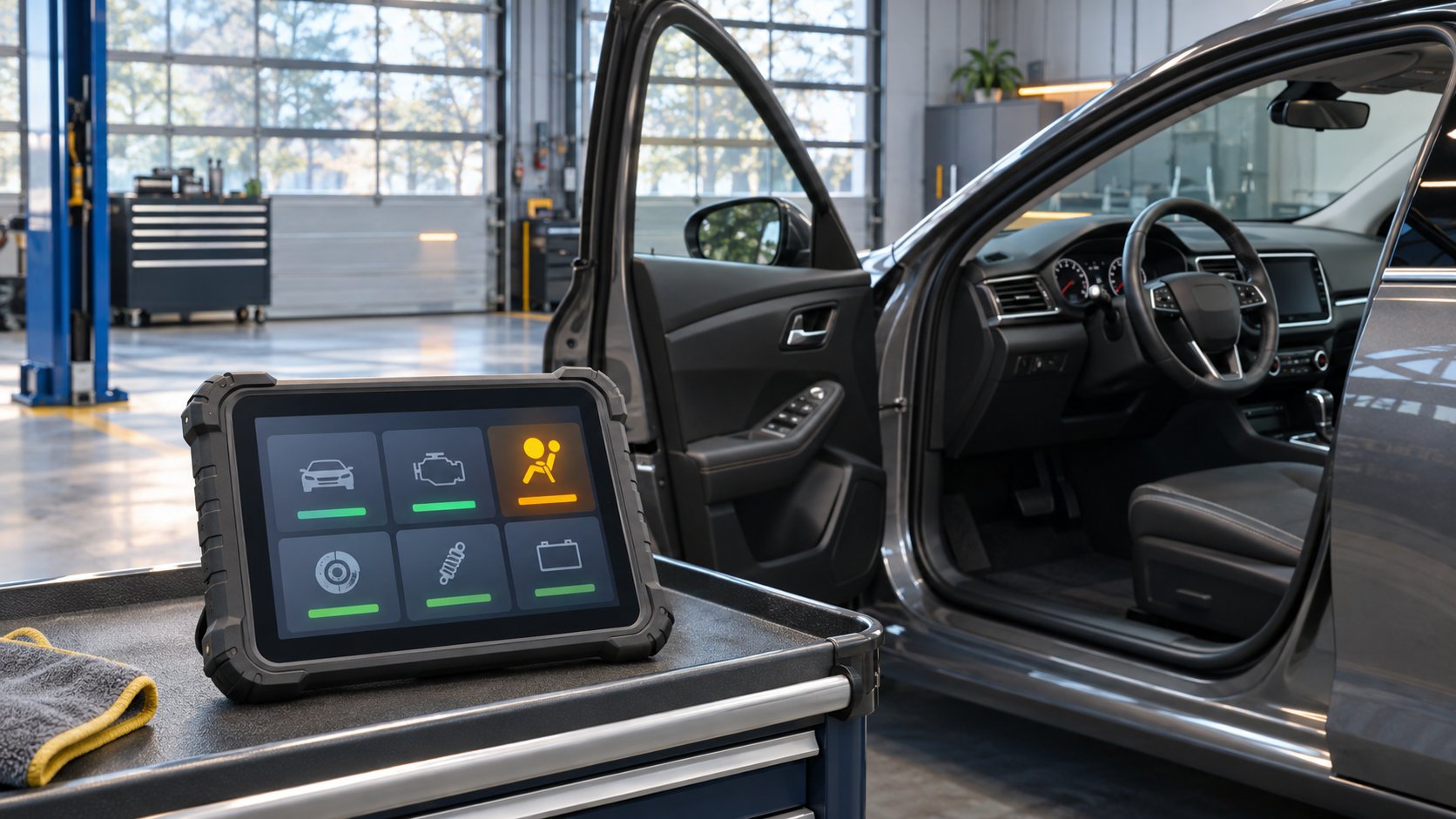
An airbag or SRS warning light means the restraint system has detected a condition that needs diagnosis. It is not the same as the normal passenger-airbag-off indicator, and it should not be treated like a routine engine code. Depending on the fault, one or more airbags or seat-belt pretensioners may be unavailable in a crash.
A safe airbag warning light diagnosis starts with the owner’s manual and an SRS-capable scanner. It does not start by unplugging a seat connector, measuring an inflator circuit or clearing every code. Supplemental restraint systems contain pyrotechnic devices and stored energy, so physical testing and repair belong with trained technicians following the exact manufacturer procedure.
What the SRS warning light means
The warning lamp normally illuminates briefly during the ignition self-check and then turns off. Toyota’s current owner guidance says an SRS lamp that indicates a malfunction can relate to the airbag system or seat-belt pretensioner system and calls for immediate inspection. The monitored network may include impact sensors, occupant-classification components, buckle switches, inflators, wiring and power sources.
A passenger-airbag-off lamp can be normal when the seat is empty or the occupant-classification system intentionally suppresses that airbag. If its behavior does not match the owner’s manual, treat that as a separate safety-system concern rather than assuming the main SRS system is healthy.
Start with evidence, not a reset
1. Record the warning state
Note whether the lamp stays on, flashes, appears intermittently or began after a collision, battery event, seat movement or interior repair. Photograph dashboard messages and check whether any other warning lamps are present. Do not cycle connectors to see whether the light changes; that can erase useful context or create another fault.
2. Perform a complete vehicle scan
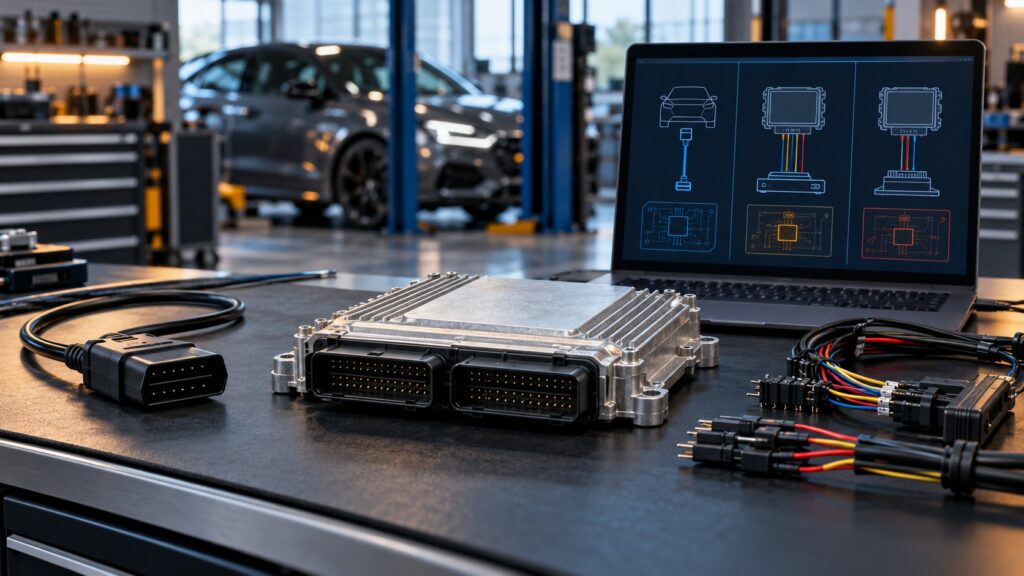
Use a diagnostic tool that explicitly supports the SRS module on the exact vehicle. Save the vehicle identification, module identification, every fault code and its status before clearing anything. A basic engine-only OBD2 reader usually cannot enter the restraint controller. A complete scan can also reveal network or power-supply faults shared with other modules.
The live XTOOL D5S listing advertises SRS fault-code reading, clearing and system-status monitoring. Coverage still varies by make, model and year, so verify the exact vehicle before buying. Scanner access identifies the direction of testing; it does not authorize work on an inflator circuit.
3. Interpret the exact code description
An SRS code is not a command to replace the named part. “Resistance high,” “signal implausible,” lost communication and internal-control-unit faults describe different test paths. Code definitions, connector locations, expected status and permitted tests must come from service information for the exact vehicle and build. Record whether a code is current, intermittent or stored after a past event.
Common diagnostic paths
| Fault area | Evidence to review | What not to assume |
|---|---|---|
| Seat or pretensioner connection | Relevant DTC, repair history and visible harness condition | Moving or reconnecting a live plug is a valid repair |
| Steering-wheel circuit | Code details and other steering-wheel function symptoms | A clockspring is faulty without the prescribed tests |
| Occupant classification | Passenger indicator behavior and vehicle-specific data | The airbag-off lamp always indicates a failure |
| Impact sensor or wiring | Collision history, DTC status and OEM wiring information | A generic resistance check is safe |
| Control module | Internal fault, deployment record and replacement rules | Clearing crash data restores the whole system |
HELLA’s airbag-system diagnostic guide notes that seat movement can contribute to poor connections around front-seat side airbags or pretensioners, and that a clockspring can be another fault source. These are examples, not permission to disturb connectors. Visual inspection and any isolation period must follow the maker’s instructions.
Why generic wiring checks are unsafe
SRS circuit-testing rules vary. HELLA describes certain continuity checks only after the battery, sensors and control unit have been disconnected from the harness, with manufacturer wiring diagrams and proper probes. By contrast, Rivian’s published SRS service guidance says never to use test lights, voltmeters, ohmmeters or probing tools on SRS components and specifies its diagnostic environment.
That difference is decisive: there is no universal “airbag resistance test.” Do not bridge a connector with a resistor, use a test lamp, back-probe a firing circuit or improvise terminals. Follow the current OEM procedure for the exact vehicle, including power-down time, connector handling, component storage and post-repair checks.
Module repair, reset or replacement?
First separate a module fault from faults elsewhere in the system. Repairing a damaged harness or connector does not automatically require a restraint controller. An internal module code, water damage, collision event or deployment can produce a different decision, and the manufacturer may require replacement and configuration.
NHTSA states that a deployed airbag cannot be reused and should be replaced by an authorized service technician. Some OEM procedures also require the restraint controller, sensors or pretensioners to be replaced after specified deployments. Erasing stored crash information is not a substitute for replacing deployed or damaged safety components.
The store’s Carprog V13.77 listing advertises airbag reset and programming functions for professionals. Availability for one module must be confirmed from the exact supported list, and a programming function does not establish that the vehicle maker permits a reset. The related Carprog capability guide can help distinguish its programming role from ordinary SRS code diagnosis.
Clear codes only after the repair
Once the approved repair is complete, reconnect and power the system exactly as specified, clear eligible codes with the diagnostic tool, and repeat the full scan. Confirm the warning-lamp self-check and any manufacturer post-repair calibration or verification. If a current code returns, the fault remains; repeated clearing does not make the restraint system serviceable.
For tools aimed at code diagnosis across several vehicle systems, browse the SpeedXperts diagnostic-tool category. Always verify SRS access for the exact vehicle rather than relying on the phrase “full OBD2.”
Airbag warning light FAQ
Can I keep driving with the airbag light on?
The vehicle may still move normally, but part of the restraint system may be unavailable. Check the owner’s manual and arrange prompt professional diagnosis; normal drivability does not confirm crash protection.
Will disconnecting the battery clear the light?
It may not clear a stored SRS code, and battery disconnection alone is not a repair. It can also affect other vehicle settings. Use the manufacturer diagnostic and power-down procedure.
Can any OBD2 scanner read airbag codes?
No. Generic OBD2 coverage mainly concerns emissions-related engine data. The tool must support the vehicle’s SRS controller and the required diagnostic functions.
A reliable diagnosis preserves the codes, uses exact service information and separates a wiring or sensor fault from a deployed-component or module decision. The warning lamp should go out because the approved repair passed verification, not because its evidence was erased.