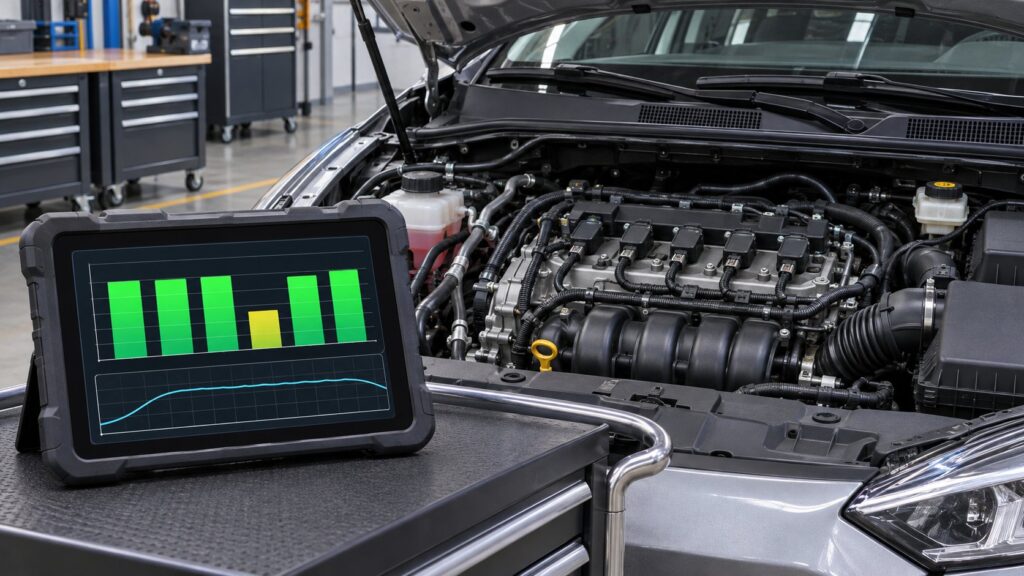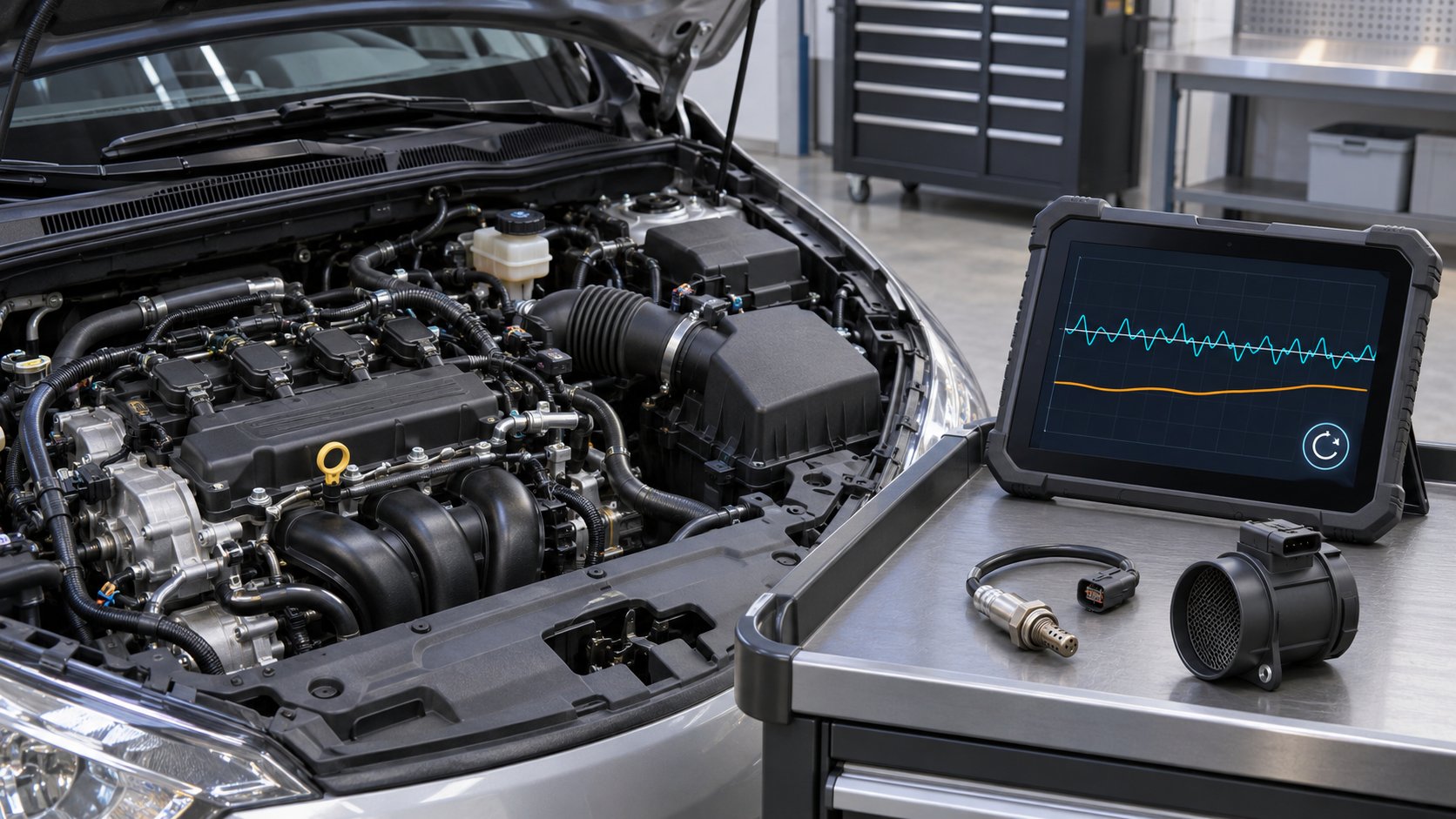
A fuel trim reset clears learned corrections that an engine control module has built while adjusting mixture. It may be a required final step after a specified sensor replacement, software update or repair. It is not a cure for a vacuum leak, weak fuel supply, leaking injector, biased sensor or exhaust leak.
That difference matters because the learned values are useful diagnostic evidence. Resetting them too early can erase the pattern that shows when and how the control system was adding or subtracting fuel. Save the data, repair the cause, and reset only when the vehicle-specific procedure calls for it.
What short-term and long-term fuel trim mean
Once the engine enters closed-loop operation, the control module compares oxygen or air/fuel sensor feedback with its target. Short-term fuel trim is the quicker correction used to keep mixture near that target. Positive correction generally means the controller is adding fuel; negative correction means it is subtracting fuel. The display may use percentages, multipliers or manufacturer-specific names.
Long-term fuel trim, also called fuel adaptation, stores a slower learned correction. Many systems divide learning into cells based on engine speed and load, so an apparently normal idle value does not prove that every operating range is normal. Volvo’s fuel-adaptation technical guidance explains how short-term correction responds quickly while long-term adaptation moves the faster correction toward the center and records learning across different load ranges.
A reset returns supported learned corrections toward their starting values. The module must then relearn as the engine operates in the required conditions. If an air, fuel or sensor fault remains, the correction will move away from baseline again.
When a fuel trim reset may be required
There is no universal list for every vehicle. Use the VIN, engine code, installed software and current service information. Valid triggers can include:
- a repair procedure that explicitly ends with fuel-trim or air/fuel adaptation reset;
- replacement of a specified oxygen or air/fuel sensor on an application that requires learned values to be cleared;
- ECM programming followed by a manufacturer-directed reset; or
- a guided diagnostic routine that commands reset after the verified repair.
Zum Beispiel, GM bulletin PI1363 instructs technicians to perform a scan-tool fuel trim reset when listed faults are present after oxygen-sensor replacement on specified 2014–2015 Chevrolet Cruze diesel vehicles. Another GM bulletin for a defined diesel Cruze condition places the reset after diagnosis, repair and ECM reprogramming. These are application-specific examples, not permission to reset every vehicle after an oxygen sensor or software update.
What a reset cannot repair
Clearing learned values cannot seal an intake leak, correct low fuel pressure, clean a restricted injector, repair an injector that leaks, restore a contaminated mass-airflow sensor, fix an aging oxygen sensor or close an exhaust leak upstream of a sensor. It also cannot make an incorrect injector calibration code or wrong replacement part correct.
Fuel-trim and oxygen-sensor faults can be caused by leaks too small to see. GM bulletin 20-NA-065 directs technicians toward approved intake and exhaust leak-detection methods when normal diagnosis does not resolve listed trim-related codes. Resetting adaptation would not find those leaks.
Reset, clear codes and relearn are different
| Operation | Zweck | Key limitation |
|---|---|---|
| Clear diagnostic trouble codes | Erases stored fault information and may reset readiness monitors | Does not guarantee that all learned fuel corrections were cleared |
| Fuel trim or A/F reset | Clears supported learned mixture corrections | Does not repair the condition that created them |
| Idle or throttle relearn | Establishes airflow or throttle references on applicable systems | Is a separate function with different prerequisites |
| Drive cycle or adaptation | Allows the controller to rebuild learning and run monitors | Must follow the manufacturer’s operating conditions |
Battery disconnection is not a reliable substitute. It may clear some volatile memory on one vehicle and leave other learned values intact on another. It can also erase evidence, reset monitors and create unrelated initialization needs. Use the named diagnostic function when the service procedure specifies it.
A practical diagnostic workflow
- Confirm the complaint and repair history. Note recent sensor, injector, intake, exhaust, battery or programming work and the conditions that set the fault.
- Save codes and freeze-frame data. Record short- and long-term trims by bank, engine speed, load, temperature, oxygen-sensor data, airflow and fuel-pressure information before clearing anything.
- Compare operating conditions. Observe idle, a steady raised speed and any safe load range identified by the OEM procedure. A correction that changes with speed can point diagnosis in a different direction from one that remains across the range.
- Test the likely system. Check unmetered air, purge flow, sensor plausibility, fuel delivery, injector operation and exhaust integrity with approved methods.
- Complete the confirmed repair. Fit the correct part, finish required coding or programming, and verify connectors and hoses.
- Run the prescribed reset. Stabilize battery voltage, meet temperature and ignition prerequisites, and follow the scan-tool prompts.
- Verify relearning. Rescan, confirm no immediate faults, and perform only the specified idle routine or drive cycle. Recheck trims when the required cells have had time to learn.
Use fuel trim as evidence before resetting it
Patterns matter more than one number. Positive correction strongest at idle can support an unmetered-air investigation; correction across a wider load range may direct attention toward airflow measurement or fuel delivery. Bank-to-bank differences can narrow the search on a multi-bank engine. Manufacturer thresholds vary, so avoid universal pass/fail percentages.
Do not reset adaptations simply to switch off a warning light or prepare a vehicle for inspection. Readiness monitors may return to incomplete, and the original fault can return after enough driving. Diagnosis should explain why the correction developed.
Safety during diagnosis and relearning
Fuel-trim diagnosis often requires a warm, running engine. Work in a ventilated area, secure the vehicle, keep clear of belts and fans, and treat exhaust components as hot. Use approved leak-testing equipment and pressures. Do not introduce flammable enrichment gas, open a pressurized fuel system or watch a handheld display while driving unless the manufacturer’s procedure and safe equipment make that work appropriate.
Choosing a scan tool
A basic code reader may display generic short- and long-term trim PIDs but lack the manufacturer reset command. The current XTOOL D7S V2.0 und XTOOL D7 V2.0 listings include both A/F Reset and Fuel Trim Reset. Coverage still varies by vehicle, engine and software, so confirm the exact function before purchase.
Our guide to active tests and service functions explains why data access does not guarantee reset capability. If injector replacement is part of the repair, also review injector coding after replacement. Compare other options in the Kategorie „Diagnosewerkzeuge“.
Fuel trim reset FAQ
Will clearing codes reset fuel trims?
It may on some systems, but it is not a reliable universal rule. Use the named reset procedure and verify the values afterward.
Should trims be reset after every oxygen sensor replacement?
No. Some manufacturer procedures require it on defined applications; others do not. Follow the service information for the exact vehicle and fault.
A fuel trim reset is most useful after the cause is known and the manufacturer calls for cleared learning. Preserve the evidence first, repair the system, reset the correct values, and verify that relearning remains reasonable.