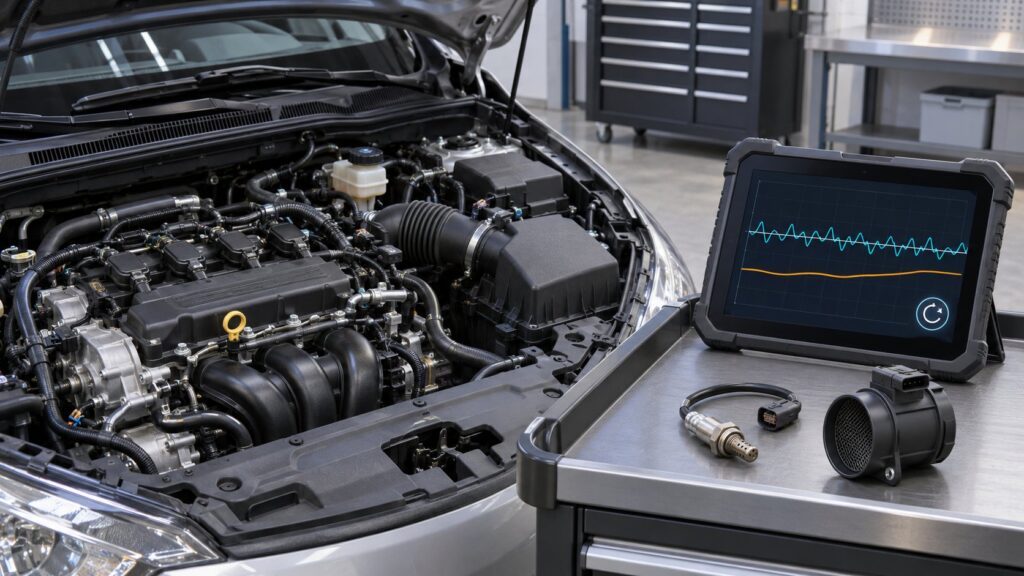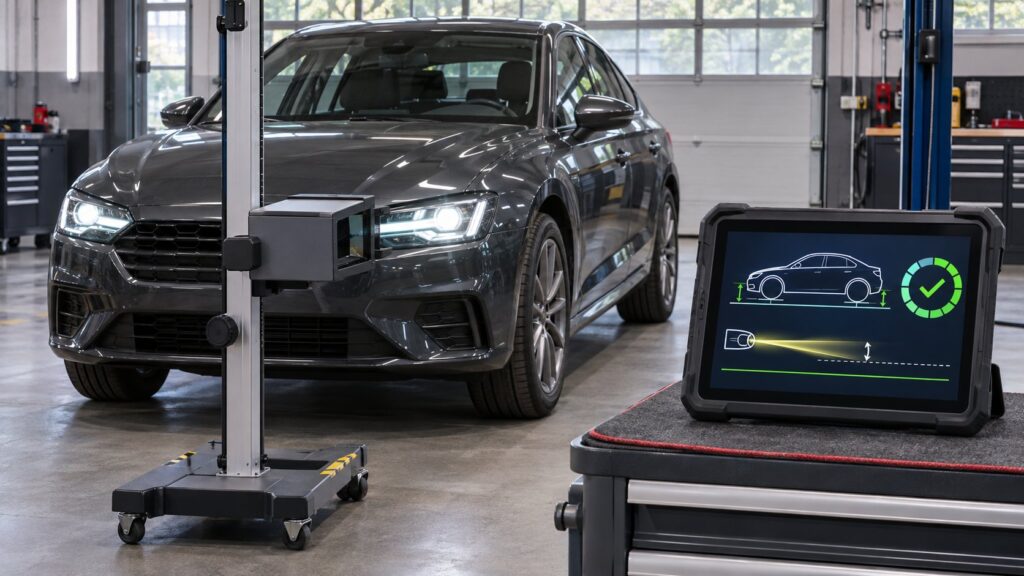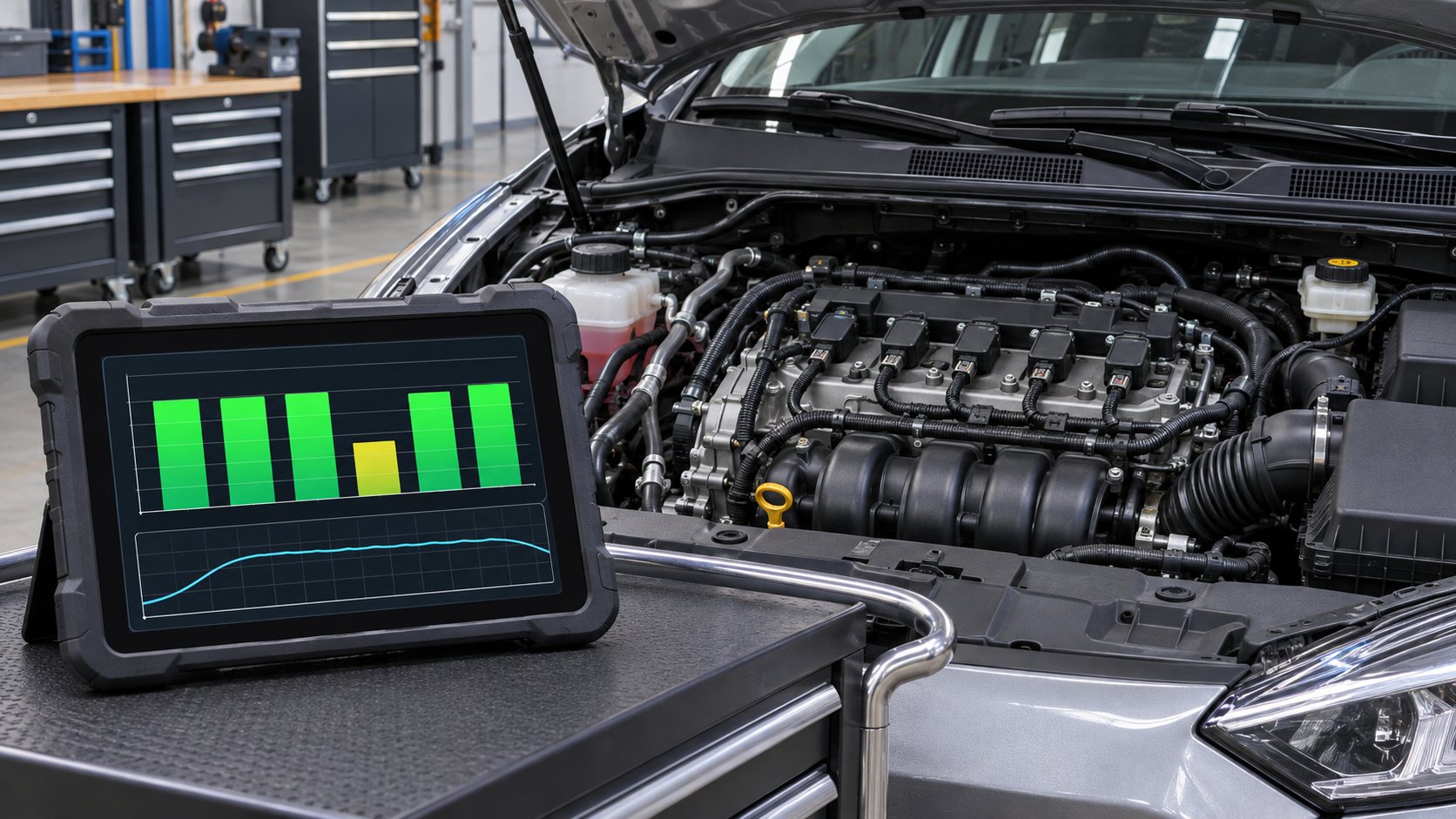
A cylinder power balance test compares how much each cylinder contributes while an engine is running. On supported vehicles, the scan tool or factory diagnostic software briefly changes injector operation and watches engine-speed response. A cylinder that produces a consistently different response becomes a diagnostic lead—not an automatic verdict that its injector, coil or internal engine parts have failed.
The test is useful when a rough idle or misfire is present but the fault code does not identify the cause clearly. Its value comes from comparison: each cylinder is tested under similar conditions, allowing the technician to see which result differs from the group.
How a power balance test works
One common routine disables or alters fuel delivery to one cylinder at a time while monitoring RPM. A healthy cylinder is doing useful work, so removing its contribution should create a measurable speed drop or change. Disabling a cylinder that was already weak usually creates a smaller change. Some systems display bars, percentages or correction values instead of a simple RPM drop.
The exact strategy varies with the engine and manufacturer. A gasoline engine routine may use injector cut-out and pair the result with misfire counters. A diesel system may show cylinder contribution, fuel correction or smooth-running values calculated by the engine controller. Heavy-duty software may present an idle contribution graph. These outputs are not interchangeable, and a universal “good” number cannot be applied to every engine.
International’s A26 diagnostic guidance, for example, displays a cylinder-contribution graph as speed rise in RPM. The useful observation is that one cylinder contributes less than the others under the prescribed idle test—not that the same threshold applies to a different engine.
What the result can tell you
A repeatable weak response can help identify the cylinder that deserves the next test. It can also help confirm whether a complaint is present at idle, compare all cylinders under one controlled routine, and verify whether a repair changed the contribution pattern.
Manufacturer procedures show how this evidence fits into a larger diagnosis. A Ford bulletin for specified V8 applications uses a cylinder power balance test to identify the suspect cylinder, then directs technicians to swap known-good ignition components and continue mechanical checks. The balance test narrows the search; it does not name the defective part.
What it cannot prove
A low-contribution cylinder can have several causes:
- a worn, fouled or incorrectly gapped spark plug;
- a weak coil, damaged boot or ignition-circuit fault;
- a restricted, leaking or electrically faulty fuel injector;
- low compression from valves, rings, a head gasket or valvetrain damage;
- a cylinder-specific intake leak or air-distribution problem; or
- wiring, connector, control-module or software issues.
The test also may look normal when an intermittent fault is absent. General Motors’ GDS2 cylinder-balance bulletin says to run the balance test when the misfire is present, repeat it three times and look for consistency. It explicitly warns against relying on the test as the only way to identify a weak cylinder.
Power balance, misfire counters and compression
| Test or data | What it indicates | Main limitation |
|---|---|---|
| Power balance or cylinder contribution | Relative work produced by each cylinder under the test conditions | Does not separate ignition, fuel and mechanical causes |
| Compteurs de ratés d'allumage | Crankshaft-speed irregularities attributed to cylinders by the control module | Identification and thresholds depend on the strategy and operating state |
| Relative compression | Difference in cranking effort or speed between cylinders | Does not measure exact sealing pressure or identify the leak path |
| Mechanical compression or leak-down | Cylinder sealing and, with leak-down, clues to where pressure escapes | Requires extra setup and still must be interpreted with valve timing and engine condition |
These tests answer different questions. If contribution is low and the fault remains after verified ignition or injector swaps, compression, leak-down, valvetrain inspection or other OEM-directed checks may be next. If injector replacement is confirmed, our injector coding guide explains why some replacements require calibration data. A crankshaft sensor relearn is a separate calibration and should not be confused with cylinder diagnosis.
A practical diagnostic workflow
- Verify the complaint. Note whether the roughness occurs cold, hot, at idle, under load or only during a regeneration or other operating mode.
- Scan before clearing anything. Save codes, freeze-frame data, misfire counters, fuel trims, rail pressure and relevant temperature values.
- Check prerequisites. Confirm oil and coolant levels, battery voltage, engine temperature, accessories, transmission position and any active faults that can invalidate the routine.
- Run the vehicle-specific test. Use the function named in the service information. Do not manually unplug injectors or coils as a substitute.
- Repeat under the same conditions. Look for a consistent outlier rather than one transient bar or RPM movement.
- Choose the next test from the evidence. Inspect ignition, fuel, wiring or mechanical condition according to the engine design and fault pattern.
- Verify the repair. Repeat the original operating condition, rescan, and compare the balance and misfire data with the saved baseline.
Safety during a running-engine test
Power balance is normally a running-engine procedure. Work in a ventilated area, secure the vehicle as the service information requires, keep clothing and tools away from belts and fans, and remember that an electric cooling fan may start without warning. Exhaust components and coolant can be hot. Do not stand in front of a vehicle that may move, and do not improvise a road test while watching a handheld screen.
Use the scan-tool routine rather than disconnecting ignition or fuel components by hand. Uncontrolled disabling can create high voltage, raw fuel, catalyst damage, additional codes or a fire risk. Stop if the manufacturer’s test aborts or the engine condition becomes unstable.
Choosing a scan tool
A generic emissions reader may show P0300-series codes but usually cannot command a cylinder balance routine. The scanner must support the engine controller and the exact function for the vehicle. Our guide to active tests and service functions explains why code access alone does not prove command capability.
The current XTOOL D7 V2.0 listing includes Power Balance Testing among its functions. Support still varies by make, model, year and engine, so confirm coverage before purchase. Browse the catégorie « outils de diagnostic » for other options.
Power balance test FAQ
Does the lowest bar mean the injector is bad?
No. It identifies lower contribution under those conditions. Ignition, fuel, compression, air, wiring and mechanical faults can produce a similar result.
Can the test find an intermittent misfire?
Only if the fault occurs during the test or leaves useful supporting data. Reproduce the documented operating condition safely and compare repeated runs.
A cylinder power balance test is strongest as a comparison tool. Save the data, confirm the outlier, and use targeted follow-up tests to prove the failed system before replacing parts.