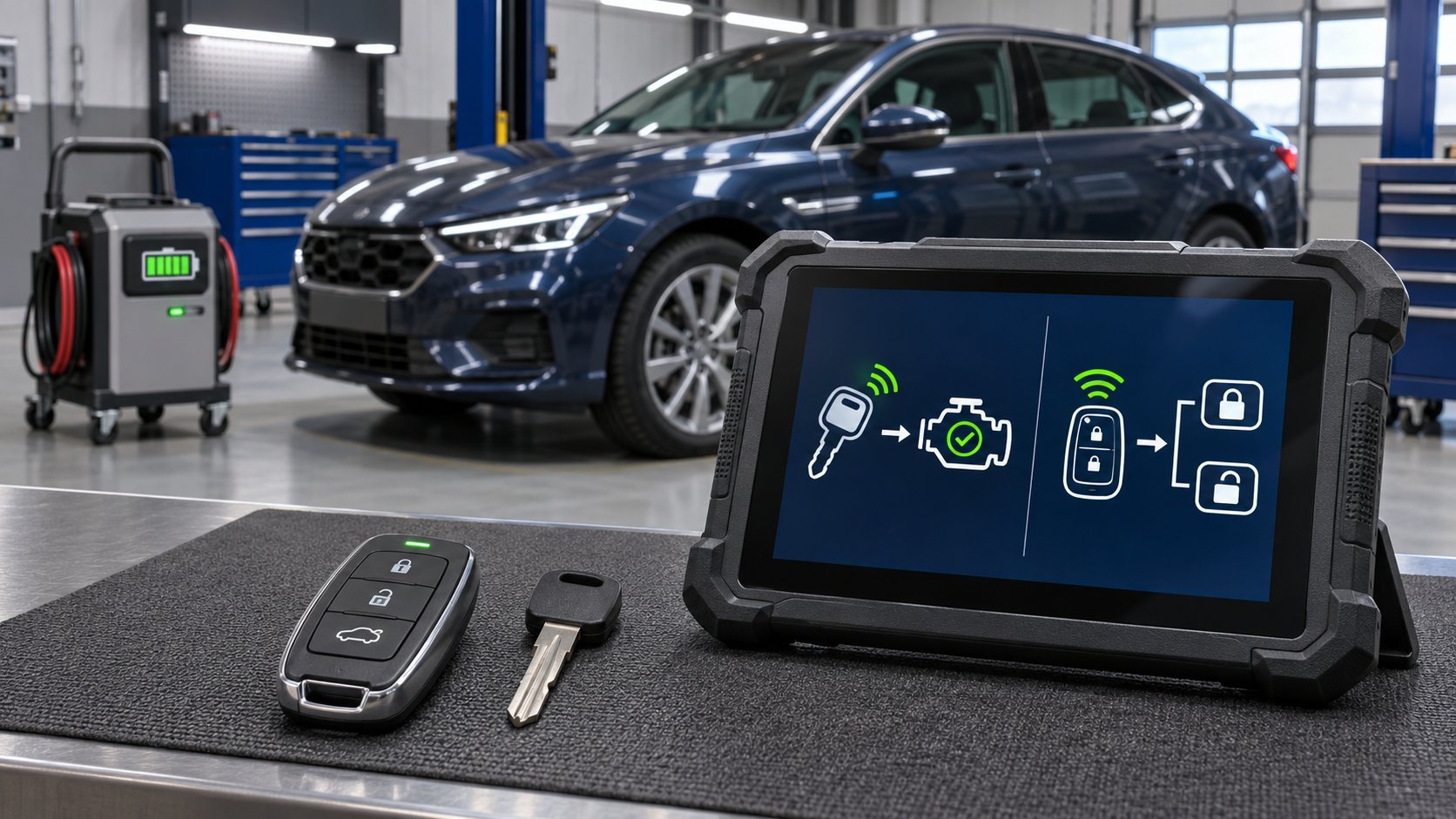
Key programming vs remote programming sounds like a choice between two names for the same job. On many vehicles, however, they control different functions. The immobilizer must recognize an authorized transponder before the engine can start, while the remote-control system listens for lock, unlock, tailgate or panic-button commands. A smart key may contain both systems in one housing, but one can work while the other does not.
That distinction matters when ordering a replacement key, choosing a diagnostic tool or diagnosing a key that starts the car but will not unlock it remotely. Vehicle design varies, so use the service information for the exact VIN and confirm that you own the vehicle or have the owner’s authorization before any security-related work.
One key can perform three separate jobs
| Key function | What it does | Typical failure symptom |
|---|---|---|
| Mechanical blade | Physically operates a lock cylinder or ignition barrel | The blade will not turn or does not match the lock |
| Immobilizer or transponder | Provides an electronic identity that permits engine starting | The doors may unlock, but the engine will not start or immediately stops |
| Remote-control transmitter | Sends button commands for locks, tailgate, alarm or other convenience functions | The vehicle starts, but remote buttons do nothing |
A key’s physical shape therefore proves very little about its electronics. GM’s PIC6401 key and transmitter bulletin explains that an ignition key can contain a transponder, while a basic metal service key has no electronics and cannot supply the immobilizer information needed for starting. It also treats transmitter programming as a defined service procedure.
What key programming usually means
In workshop language, key programming normally means registering a transponder, integrated key or smart key with the vehicle’s immobilizer system. The controller compares the presented identity with authorized data before allowing the engine or high-voltage system to operate. The exact modules involved can include a body controller, immobilizer unit, instrument cluster, steering-column module or engine controller.
Programming a key is not the same as cutting its blade. It is also not automatically the same as replacing or synchronizing an immobilizer control module. GM service information for one recall states that its add-key function learns vehicle-key information but does not perform the separate immobilizer learning between the body and engine controllers. Labels must be read in the context of the selected vehicle, not as universal promises.
What remote programming usually means
Remote programming, remote learning or transmitter learning associates the key’s button transmitter with the receiver in the vehicle. It can restore lock and unlock commands even when the transponder is already authorized. On some integrated keys, one OEM procedure teaches both portions; on others, the immobilizer and remote require separate routines.
Ford’s current remote-control guidance also notes that changing the remote battery does not erase a programmed remote. If the buttons stop working after a battery change, first check battery type, orientation, contacts and the condition of the fob instead of assuming the vehicle lost its programming.
Add-key and replace-all are different operations
An add-key routine normally preserves existing authorized keys and uses the next available memory position. A replace or all-keys-lost routine may erase previously learned keys before registering the replacements. GM’s PIC6401 bulletin makes this distinction explicit: adding does not erase existing devices, while replacement begins by removing the known keys and transmitters from memory.
This is why “all keys lost” should never be selected as a shortcut for adding a spare. An incorrect choice can disable a working key, and some vehicles require online authorization, security credentials, a waiting period or factory equipment. Confirm the intended result and count every working key before starting.
Checks to make before programming
- Verify ownership and VIN. Security work should follow the applicable identity and authorization process. A GM key recall procedure required proof of ownership and both sets of keys at the appointment.
- Identify every function required. Confirm whether the job involves a mechanical blade, immobilizer start authorization, remote buttons, passive entry or all of them.
- Match the replacement part. Appearance alone is insufficient. Part number, transponder family, radio specification, region and vehicle equipment can affect compatibility.
- Test the current key and vehicle. Record which keys start the vehicle and which buttons work. Diagnose low vehicle voltage, a weak fob battery, receiver faults, damaged antennas and related fault codes first.
- Check coverage by exact vehicle. A tool’s general key-programming label does not guarantee support for every year, market, system or all-keys-lost case.
- Use stable power and follow prompts. Keep an approved support unit connected when the OEM procedure requires it. Do not interrupt communication or move keys into or out of the vehicle unless instructed.
- Verify every result. Test starting, lock and unlock, tailgate, passive entry, emergency-start position and each retained key as applicable.
Diagnosing common mixed symptoms
If the engine starts but the buttons fail, concentrate first on the remote battery, transmitter, receiver and remote-learning status. If the buttons work but the engine does not start, check the immobilizer warning, transponder compatibility, antenna and diagnostic faults. Honda’s 2026 Passport guidance shows another useful distinction: a weak keyless-remote battery may require holding the remote close to the start button, but the key must still be pre-registered.
A no-start is not proof that the key needs programming. Low vehicle voltage, a damaged key, interference from another key, a failed antenna or a control-module fault can produce similar symptoms. Read the relevant modules and follow the OEM test plan before erasing anything.
Choosing a suitable tool
The current XTOOL X100PADS V2.0 listing includes key programming, all-keys-lost support and remote-control learning among its advertised functions. Actual coverage depends on the vehicle, market, software, adapters and authorization requirements. Confirm the exact function before purchase or service.
For a broader view of programming equipment, see our Carprog capability guide, or compare equipment in the catégorie « outils de diagnostic ».
Key programming FAQ
Can a key start the vehicle if its remote buttons do not work?
Yes. The immobilizer transponder and button transmitter can be separate systems even when they share one case.
Does a new remote battery require programming?
Usually not, but follow the owner’s manual for the exact vehicle. Incorrect battery installation or damaged contacts can imitate lost programming.
Should every key be present during service?
Bring every key you want to retain. Some replace-all procedures erase prior entries, so keys absent from the session may stop working.
Understanding key programming vs remote programming prevents unnecessary resets and wrong-part purchases. Define the failed function, verify the replacement key and coverage, choose the correct add or replacement routine, and confirm both starting and remote operation when the work is complete.