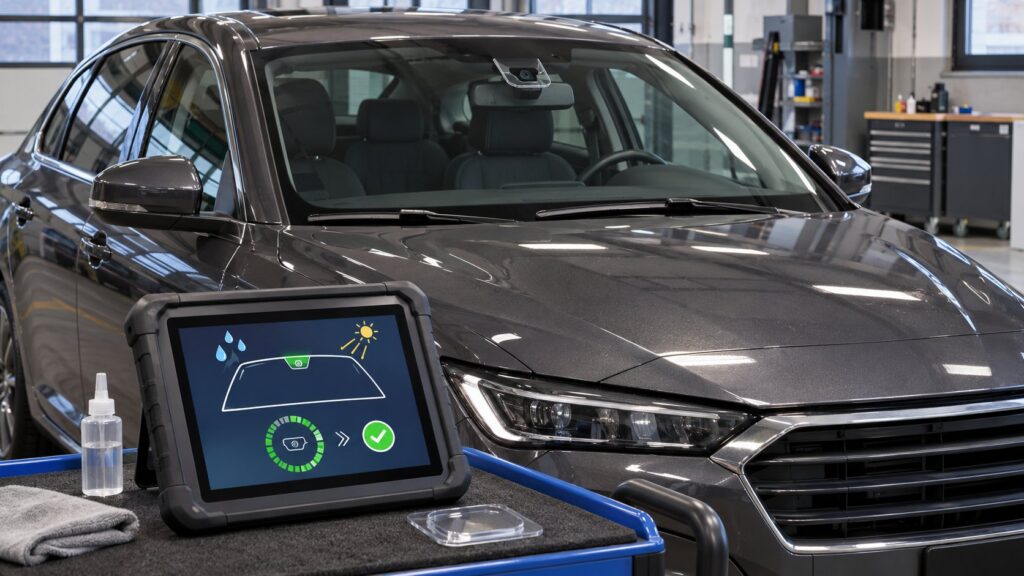
Clutch adaptation is the scan-tool procedure that teaches an automated manual or dual-clutch transmission where its clutch begins to engage and how the actuator travels. After certain clutch, actuator, transmission or control-module repairs, those learned values may no longer match the hardware. The result can be harsh take-off, hesitation, slip, an unsuccessful gear engagement or a stored fault—even when the new parts are installed correctly.
This is not a routine for an ordinary manual gearbox with a driver-operated clutch pedal. It is also more specific than a general transmission adaptation reset. The exact name varies by manufacturer: clutch adaptive learn, clutch characteristic learning, touch-point learning, kiss-point learning or DCT learning.
What the transmission is learning
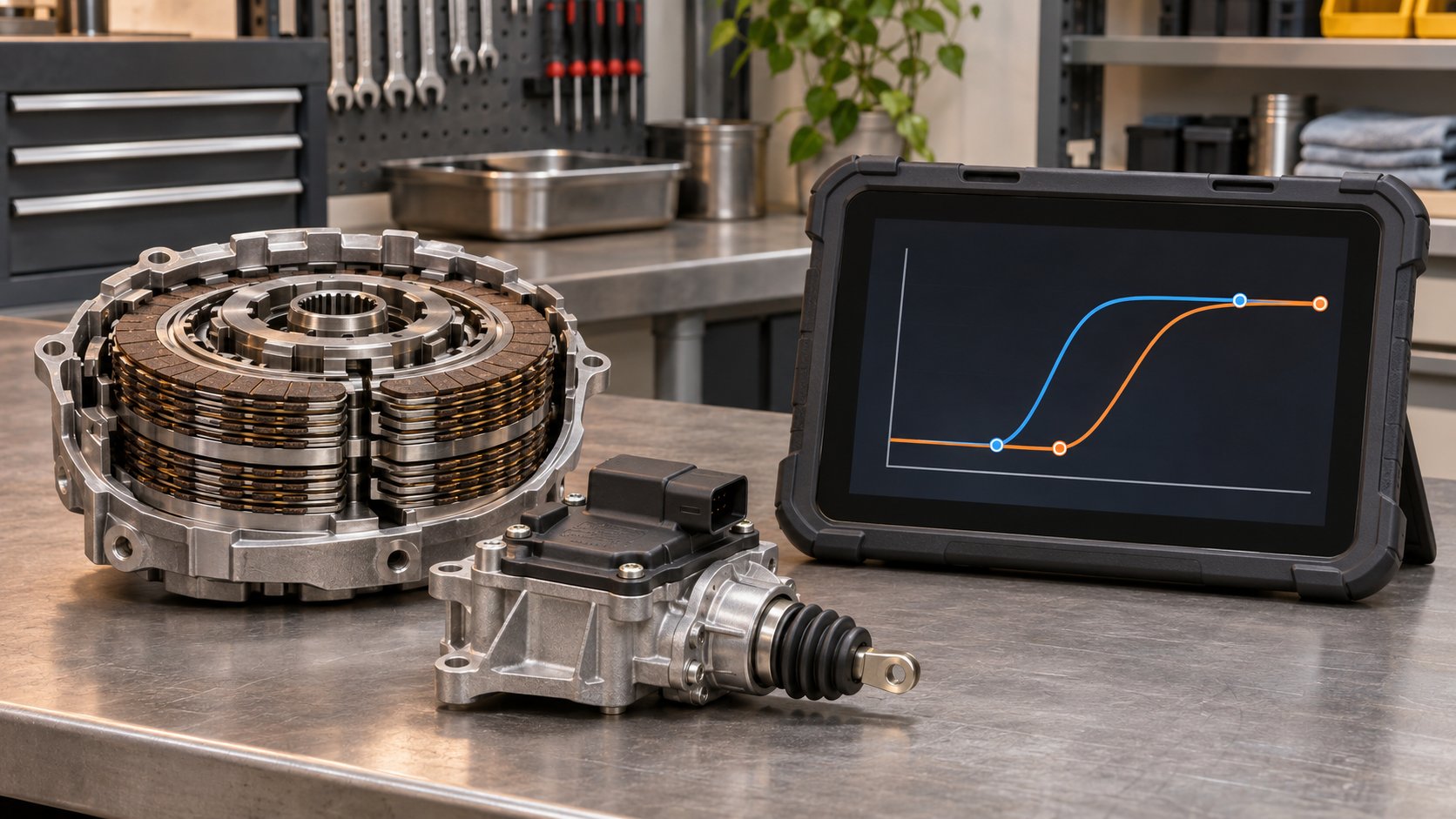
An automated clutch needs a reliable reference between fully released and fully applied. The important transition is the touch or kiss point, where the friction surfaces begin to transmit torque. A control module combines that point with actuator position, clutch temperature, engine speed and other data to manage smooth engagement.
New friction material, a replacement actuator or a changed clutch stack can move that reference. Production tolerances also mean that two apparently identical assemblies may not share the same travel values. A prescribed learning routine moves the actuator through controlled positions and stores new limits or characteristics. Some systems learn each clutch separately; others include gearbox geometry and selector-position steps.
That distinction matters. A scan tool does not mechanically adjust the clutch. It commands the manufacturer-defined routine and reports whether the module accepted the result.
When clutch adaptation may be required
Use the service information for the exact vehicle, transmission code and repair. Common triggers include:
- replacement of a dry or wet dual-clutch pack;
- replacement of a clutch actuator motor or concentric actuator;
- replacement of a DCT or automated manual transmission assembly;
- replacement of a gear actuator, input sensor, mechatronic unit or transmission control module when the manufacturer specifies learning;
- TCM programming or initialization that clears learned clutch values; and
- a repair procedure that explicitly ends with touch-point or clutch characteristic learning.
Hyundai’s published Veloster DCT bulletin, for example, calls for DCT learning after replacement of the transmission, clutch actuator motor, gear actuator assembly, input sensor or TCM. Its routine covers gearbox geometry, clutch characteristics and shift position. A Ford DPS6 campaign similarly pairs PCM/TCM programming with a clutch adaptive learn. These examples show why the repair manual, rather than a universal checklist, decides when the step applies.
What a relearn cannot repair
Calibration cannot restore burned, contaminated or worn friction material. It cannot seal a hydraulic or pneumatic leak, remove air from a circuit, straighten damaged clutch or flywheel parts, correct an incorrectly installed assembly, restore a weak actuator, or repair wiring and mechatronic faults. It also cannot compensate indefinitely for excessive clutch travel.
If adaptation fails, record the message and data instead of repeating the routine until it passes. A failure can be useful evidence: an actuator may not reach its expected limit, a prerequisite may be missing, a fault may still be active, or the installed component may be wrong for the calibration.
A practical diagnostic workflow
- Confirm the complaint and repair history. Note whether the concern began before or after clutch, actuator, transmission or module work.
- Identify the transmission precisely. Use the VIN, transmission code and module identification. Similar model years can use different gearboxes and routines.
- Scan every related module. Save fault codes, freeze-frame data, actuator position, clutch temperature and programming information before clearing anything.
- Check the mechanical and electrical basics. Inspect connectors, grounds, fluid level or bleeding status where applicable, actuator installation and part numbers. Resolve active faults that block learning.
- Read the OEM procedure. Confirm required software, initialization order, transmission temperature, selector position, brake application and whether a road evaluation follows.
- Stabilize system voltage. Use the power support specified for the vehicle. A voltage drop during programming or actuator movement can interrupt the procedure.
- Run the exact routine once prerequisites are met. Keep the tool connected, follow prompts in order and do not cycle the ignition unless instructed.
- Verify the result. Recheck codes and learned values, then perform only the manufacturer’s specified stationary checks or drive cycle.
Safety and setup are part of the procedure
A clutch-learning routine can command actuators and may allow the vehicle to engage or move. Work on a level surface, keep people and equipment clear, and secure or raise the vehicle exactly as the service procedure requires. Parking-brake, wheel-chock, foot-brake and lift instructions vary; do not substitute a remembered sequence from another transmission.
Temperature matters on many systems. A routine may require a defined coolant, transmission-fluid or clutch temperature window. A later Hyundai wet-DCT bulletin, for example, shows initialization and transmission learning followed by a controlled forward/reverse evaluation. That is not permission to invent a drive routine. Use the OEM steps for the vehicle being repaired.
Choosing a scan tool for the job
A generic code reader cannot perform clutch learning. The tool must communicate with the correct transmission module and expose the specific service function for the vehicle. Confirm support by VIN, model year, transmission and software version before disassembly. The words “full system” or “bidirectional” alone do not guarantee this routine; our guide explains the difference between active tests and service functions.
Current SpeedXperts listings for the XTOOL D7S V2.0 en XTOOL D7 V2.0 name Clutch Adaptation among their service functions. Coverage still depends on the particular vehicle and transmission, so verify it before purchase or repair. You can compare alternatives in the categorie ‘diagnostische hulpmiddelen’.
Successful learning is the final check, not the first repair
Clutch adaptation belongs at the end of a correct mechanical and electrical repair. When the applicable service information requires it, skipping the step can leave new hardware working from obsolete reference values. When hardware is faulty, repeatedly resetting values can hide evidence without fixing the cause.
Start with identification, codes and live data; repair the fault; meet every prerequisite; then carry out the named learning routine. That sequence gives the control module a sound clutch to learn and gives the technician a result that can be trusted.