A soft brake pedal after hydraulic work does not always mean that ordinary bleeding was performed badly. On some vehicles, air can remain inside the anti-lock braking system’s hydraulic control unit, where normal pedal or pressure bleeding may not move it into the wheel circuits. ABS bleeding with a scan tool addresses that specific problem by commanding the pump and solenoid valves through a vehicle-specific service routine.
This is not a universal extra step for every brake-fluid change. Whether it is required depends on the vehicle, the repair performed and where air may have entered. Brake systems are safety-critical, so the correct workshop information, specified fluid and suitable equipment must take priority over a generic online sequence.
Why air can remain trapped inside an ABS unit
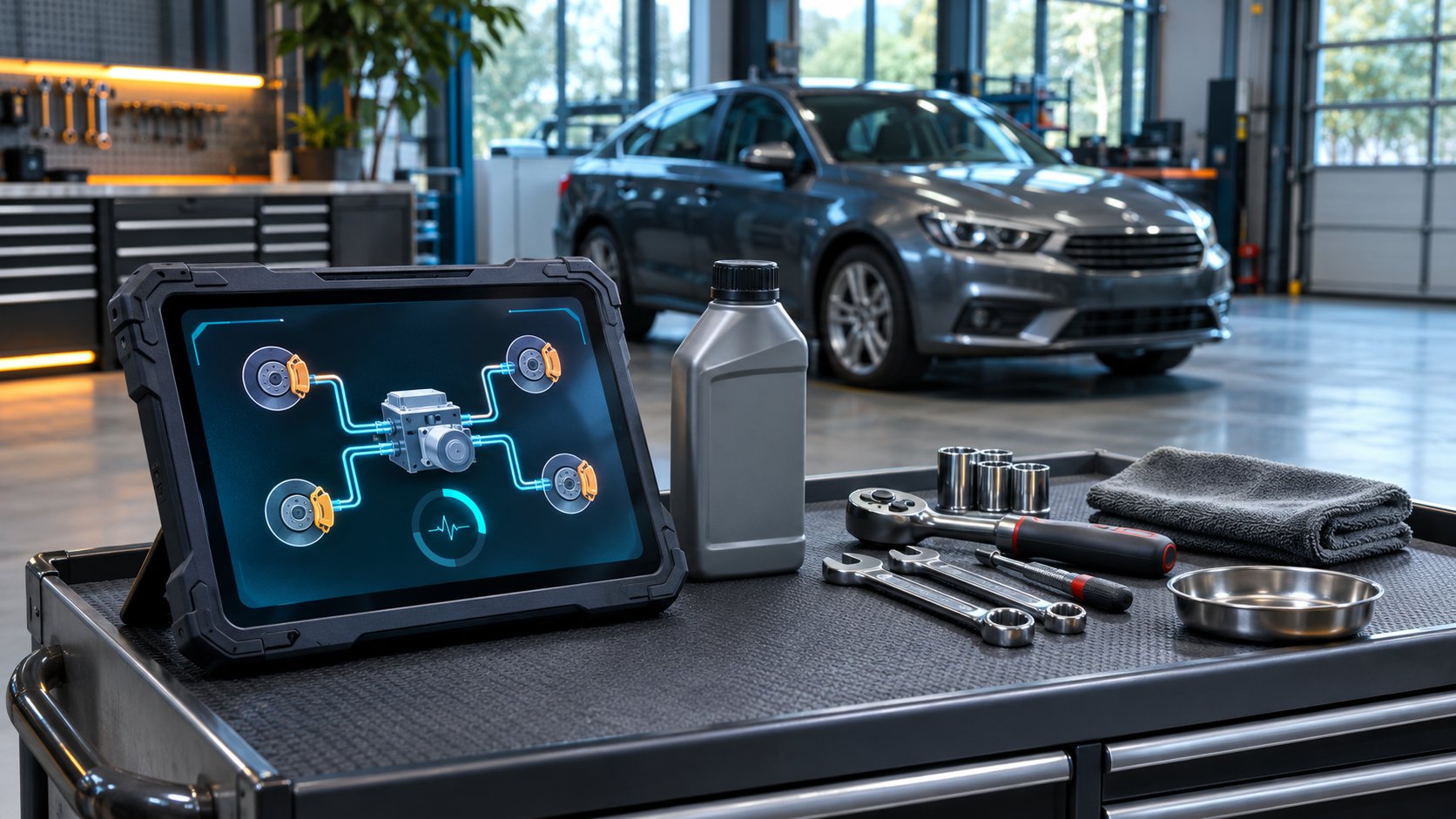
A conventional hydraulic brake system connects the master cylinder to the wheel brakes. An ABS-equipped vehicle adds a hydraulic control unit, often called an HCU, modulator or brake pressure modulator valve. Inside it are electrically controlled valves, a pump and internal passages used to reduce, hold and restore pressure during an ABS event.
During ordinary braking, some of those passages are not opened in the same way as they are during ABS operation. If the reservoir runs empty, a hydraulic line near the modulator is opened, or the HCU is removed or replaced, air may enter areas that a normal bleed cannot flush effectively. A scan-tool routine can cycle the valves and pump so that trapped air moves back into circuits that can then be bled at the wheels.
When is scan-tool ABS bleeding usually needed?
The trigger is the vehicle manufacturer’s procedure, not simply the presence of ABS. Common situations that may call for an automated or service bleed include:
- replacement or removal of the ABS hydraulic control unit;
- opening hydraulic lines at or upstream of the modulator;
- major fluid loss or a reservoir that was allowed to run dry;
- suspected air inside the HCU after a conventional bleed; or
- a model-specific repair instruction that explicitly requires the routine.
By contrast, a routine fluid change or work confined to a caliper may require only the specified conventional procedure on many vehicles. The difference matters: unnecessary pump activation adds work, while skipping a required routine can leave a low or spongy pedal.
OEM instructions also vary. A Stellantis service procedure in the NHTSA investigation archive calls for bleeding the base system, running the scan-tool ABS bleed function, and bleeding the base system again when the HCU may contain air. A separate GM service bulletin shows brake-valve cycling as a special function for a particular repair. These examples demonstrate why one sequence should not be copied across makes and models.
What the scan tool actually does
The service function communicates with the ABS control module and follows a programmed routine. Depending on the application, it may run the electric pump, open and close individual inlet or outlet valves, request pedal application, or pause while a technician performs a conventional bleed step. The diagnostic tool does not extract air by itself; it changes the hydraulic path so suitable bleeding equipment can remove it.
This is also different from an ABS active test. A tool may be able to command a pump motor or valve for diagnosis without providing the complete guided bleed routine. Our guide to active tests versus service functions explains that distinction. For brake work, confirm the dedicated bleed function for the exact vehicle, model year and ABS system.
A reliable workflow before starting the routine
- Identify the system and read the OEM procedure. Confirm the correct fluid specification, bleed order, equipment, ignition state and conditions for that vehicle.
- Find and repair the cause. Inspect for leaks, damaged components and incorrect connections. A scan routine cannot compensate for a hydraulic fault.
- Check diagnostic communication. Scan the ABS module and resolve faults that would prevent the pump or valves from operating as commanded.
- Bleed in the prescribed stages. Many procedures use a conventional or pressure bleed before the scan-tool routine and another bleed afterward, but the order is vehicle-specific.
- Verify the result before road use. Check fluid level, leaks, pedal height and firmness, warning lamps and any completion checks required by the service information.
A Volkswagen service document in NHTSA’s archive likewise directs technicians to use special bleeding routines after relevant brake service and to follow workshop-manual instructions. That qualification is essential because even closely related vehicles can use different modulators and routines.
Choosing a scanner for ABS bleeding
Start with coverage, not the number of service icons on the product page. The tool must support the bleed routine in the installed ABS module, and coverage can differ by region, year, engine, trim and control-unit version.
Current SpeedXperts listings include ABS bleeding among the service functions for the wireless XTOOL A30D V2.0 and the workshop-oriented XTOOL D7S V2.0. The XTOOL D7 V2.0 also lists the function. These listings establish a feature category, not guaranteed support for every vehicle. Check the manufacturer’s current coverage data before purchase or repair. You can compare more options in the kategorin ”diagnostiska verktyg”.
Safety points that should not be skipped
Brake fluid can damage paint and irritate skin and eyes. Use suitable protection, keep the reservoir from emptying, collect discharged fluid safely and never reuse contaminated fluid. Support the vehicle correctly if wheel access is required. Maintain the electrical conditions specified by the manufacturer because an interrupted pump routine may leave the procedure incomplete.
Do not drive a vehicle with a sinking, unusually low or spongy pedal. If the pedal does not meet the manufacturer’s acceptance checks, stop and diagnose the hydraulic system rather than repeating a service function blindly. Professional repair is the appropriate choice when the required equipment, workshop information or experience is unavailable.
Vanliga frågor
Does every brake-fluid change need a scan tool?
No. Many vehicles allow routine fluid replacement with a conventional method. Use the scan-tool routine when the manufacturer requires it or when air is suspected inside the ABS hydraulic unit.
Can a basic OBD2 code reader bleed ABS?
Usually not. Generic OBD2 emissions functions do not include ABS service routines. The scanner needs enhanced communication with the vehicle’s ABS module and application-specific bleed support.
Will activating the ABS pump fix a spongy pedal?
Only if trapped air in the modulator is the cause and the rest of the prescribed bleed is completed correctly. Leaks, flexible-hose expansion, mechanical adjustment problems or a faulty component require diagnosis and repair.
Is ABS bleeding the same as an ABS pump active test?
No. An active test may briefly command a component for diagnosis. A dedicated bleed function coordinates pump and valve operation with the hydraulic bleeding procedure.