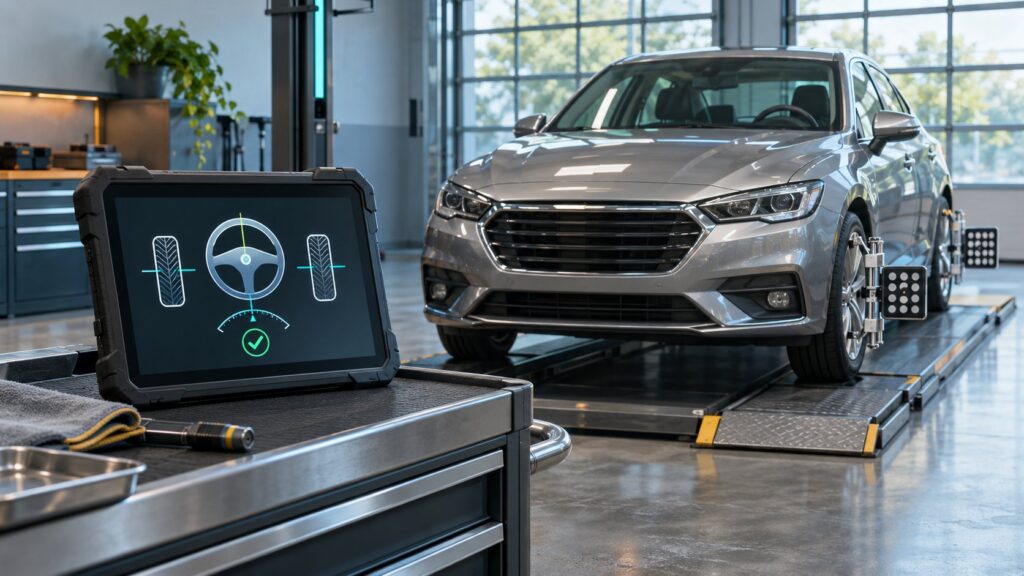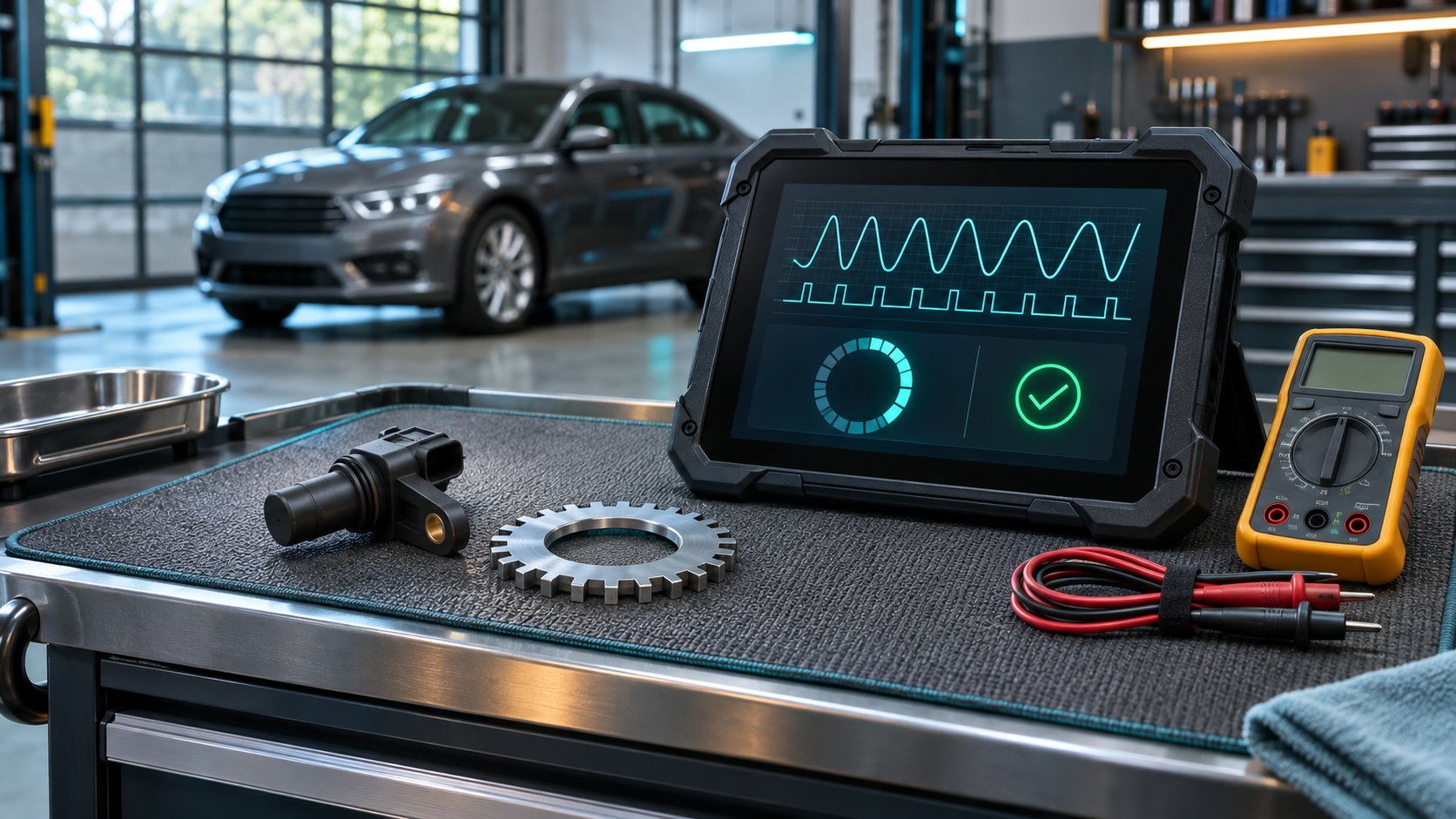
A crankshaft position sensor relearn teaches the engine control module the small, repeatable variation in the crankshaft signal on a specific engine. On some vehicles it is called crankshaft variation learn, CKP pattern learn or CASE relearn. It can be required after defined repairs or programming, but it is not a way to fix a failed sensor, damaged reluctor, timing problem or true misfire.
The procedure can involve a brief commanded rise in engine speed, so guessing is unsafe. Vehicle-specific service information must define the trigger conditions, preparation and completion criteria. A scan-tool menu label alone does not establish that the routine applies.
What does a crankshaft relearn teach?
The crankshaft position sensor reads a toothed wheel or reluctor as the crankshaft rotates. The control module uses that signal for engine position and speed. It can also analyze very small changes in crankshaft acceleration to help identify misfire. Manufacturing tolerances and the relationship between the sensor, reluctor and rotating assembly create a characteristic pattern that the module may need to learn.
A successful relearn stores that reference pattern. It does not move the sensor, correct mechanical timing, straighten a damaged reluctor or repair wiring. It also does not “calibrate” a replacement part that produces a bad signal. The physical system must be correct first.
When can a CASE relearn be required?
Requirements vary by engine and manufacturer. On covered applications, service information may call for learning after:
- crankshaft position sensor replacement;
- crankshaft, reluctor, flexplate, flywheel or balancer work;
- engine replacement or a repair that changes the relationship between the crankshaft and sensor;
- engine control module replacement, programming or a relevant calibration update;
- clearing learned crankshaft values; or
- DTC P0315 when diagnosis confirms that variation data is missing rather than a signal or mechanical fault.
A Freightliner Custom Chassis bulletin, for example, requires CASE learn after crankshaft sensor, balancer or crankshaft replacement on the covered vehicles. A 2024 General Motors bulletin calls for CKP sensor/reluctor variation learn after a specified ECM software update. Those examples show why the repair history and exact application matter.
Do not assume every crankshaft sensor replacement on every vehicle needs the same routine. Some systems learn differently, and others may not expose a service function at all. Follow the current service procedure for the VIN, engine and software level.
P0315 does not automatically mean “replace the sensor”
DTC P0315 generally indicates that crankshaft position variation has not been learned or is unavailable. That wording does not prove the sensor itself is defective. The module may have lost learned data, a required procedure may not have completed, software may need correction or the signal may be distorted by a physical fault.
Kia guidance for certain 3.3L GDI engines makes the distinction clear. It directs technicians to inspect the crankshaft sensor waveform. A good, even pattern leads to the relearn procedure; a pattern with a dip or variation leads to flexplate diagnosis and replacement on the affected vehicle. Repeating relearn cannot make a damaged trigger pattern uniform.
A separate Hyundai service bulletin calls for resetting crankshaft sensor learning after replacement of the sensor or drive plate, followed by drive-cycle verification. The repair comes before the reset.
What should be diagnosed before relearn?
- Record all codes and data. Save freeze-frame information, misfire counters and relevant crankshaft/camshaft synchronization data before clearing anything.
- Check the repair history. Confirm whether a sensor, engine, reluctor, flexplate, balancer or control module was replaced or programmed.
- Inspect the electrical circuit. Check connector condition, terminal fit, harness routing, power or reference circuits, ground and signal integrity according to the wiring diagram.
- Verify the signal and mechanical relationship. A scope pattern can reveal dropouts, irregular tooth spacing or excessive movement. Mechanical timing, reluctor installation and end play may need inspection.
- Resolve other faults. Active misfire, cam/crank correlation, throttle, temperature, transmission or voltage codes can prevent the routine or make it unsafe.
- Confirm the exact OEM trigger. Perform relearn only when service information or a validated diagnostic path requires it.
Why a generic relearn procedure is risky
Some routines require the engine at operating temperature, the transmission in Park or Neutral, the parking brake applied, accessories off and specific diagnostic conditions satisfied. The scan tool may command or request a rapid engine-speed change. Thresholds and abort logic vary. Publishing one RPM target or pedal sequence for all cars would be inaccurate and could damage an engine with an unresolved fault.
Use a well-ventilated professional work area, keep people and loose items away from the vehicle, and follow every on-screen and OEM instruction. Do not continue if the engine runs abnormally, warning conditions appear or the tool reports that prerequisites are not met. A Honda service procedure illustrates the correct principle: select the applicable CKP pattern-learning function in the factory diagnostic system and follow its prompts rather than improvising a sequence.
How to verify the result
A completion message is only one check. Cycle the ignition as directed, rescan every relevant module, confirm that P0315 does not return and review misfire or synchronization data. Test the original complaint under the conditions that produced it. If the learn repeatedly aborts or a code returns, stop repeating the routine and diagnose the unmet prerequisite, signal, software or mechanical cause.
Choosing a scan tool
The live SpeedXperts listing for the XTOOL A30D V2.0 currently includes “Crankshaft Position Learning” among its service functions. Coverage varies by make, model, year, engine and software, so confirm the exact vehicle and routine before purchase or service.
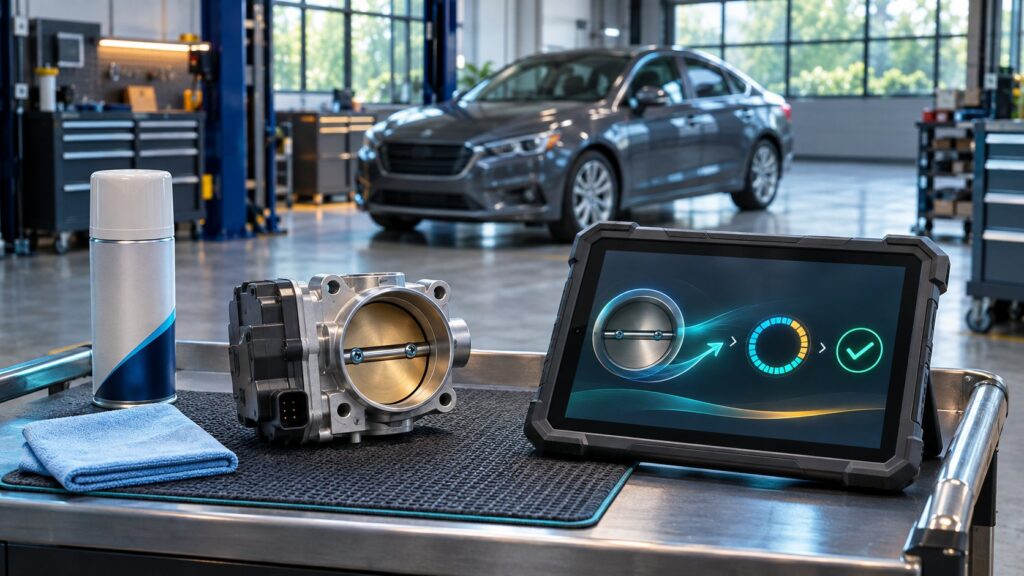
Browse the samling av diagnostiska verktyg and read our guide to active tests and service functions. Vår throttle body relearn guide also explains why similarly named learning procedures still require different prerequisites and repair logic.
Vanliga frågor
Does replacing a crankshaft sensor always require relearn?
No. It is required only when the service information for that vehicle and repair specifies it. Verify by VIN and engine.
Will relearn fix P0315?
It can clear P0315 when valid variation data is missing and all prerequisites are met. It will not repair a bad waveform, wiring fault, damaged reluctor, incorrect timing or software issue.
Is crankshaft relearn the same as clearing codes?
No. Clearing a code erases diagnostic information. Relearn performs a defined routine so the module can store a crankshaft reference pattern.
Can relearn fix a misfire?
It can restore accurate misfire monitoring after applicable service, but it does not repair ignition, fuel, compression, timing or mechanical causes of a real misfire.
Crankshaft learning belongs at the end of a correct repair path. Confirm the application, preserve diagnostic evidence, prove the electrical and mechanical signal is sound, complete the exact prompted routine and verify the code and complaint are gone.