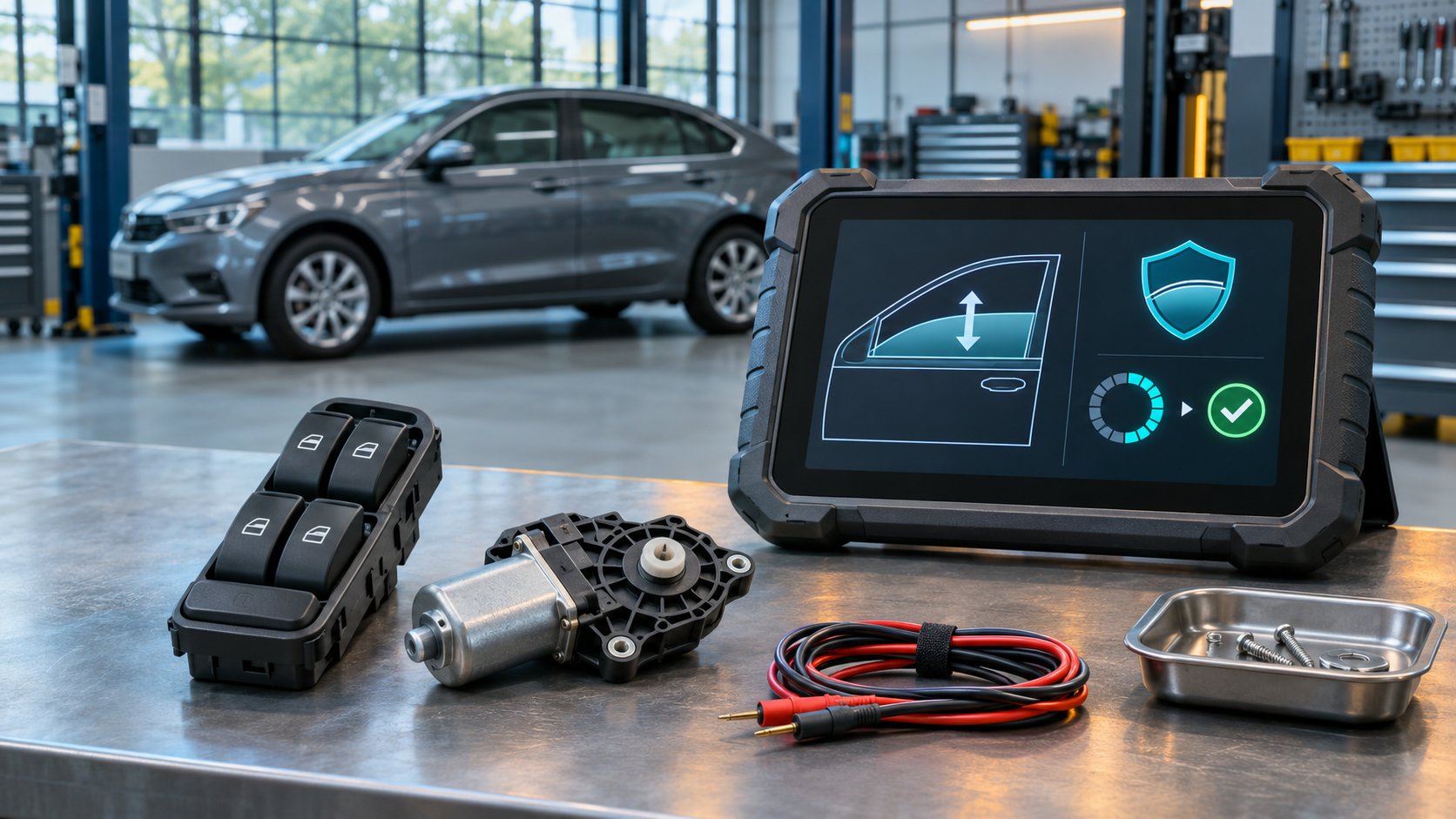
Power window initialization teaches a door or body control module the window glass’s fully open and fully closed positions. On vehicles that require it, losing those reference points can disable one-touch auto-up/auto-down and anti-pinch operation after battery disconnection or window-system repair.
Initialization is not a universal cure for an inoperative or reversing window. A binding regulator, misadjusted glass, weak motor, faulty switch, damaged wiring or door-module communication fault must be diagnosed and repaired first. The correct relearn method also varies: some vehicles use a switch sequence, while others require a scan-tool service function.
What does window initialization learn?
Many power-window motors contain electronics that track glass position and motor load. The controller uses learned endpoints to stop the glass correctly, provide one-touch movement and recognize abnormal resistance during automatic closing. When it detects a possible obstruction, the anti-pinch or jam-protection strategy can stop and reverse the window.
If position memory is missing, the system may disable automatic closing, operate only while the switch is held, move in short steps or flash a switch indicator. A Lexus bulletin explains that loss of stored window position after a fuse or battery event makes one-touch and jam-protection functions inoperative on the covered vehicle until each door window is initialized.
A Mitsubishi technical bulletin describes another implementation: when the motor’s controller detects a non-initialized condition, auto-up with anti-pinch is prohibited until initialization is completed. These examples show why the process affects both convenience and safety.
When can power window relearn be required?
- after disconnecting or replacing the battery on a vehicle whose procedure specifies initialization;
- after removing a window fuse or interrupting power to the door module;
- after replacing the window motor, regulator, switch or door control module;
- after removing, adjusting or replacing the door glass or related run channels;
- after door repair that changes glass travel or mechanical alignment; or
- when a diagnostic routine reports that endpoint learning is incomplete.
A Subaru service bulletin reminds technicians to initialize the applicable power windows after battery disconnection or switch replacement to restore proper auto-up/down operation. That instruction applies to the covered vehicles; other models may retain memory, relearn automatically or require a different trigger.
What initialization cannot repair
Relearning endpoints cannot fix worn regulator cables, a bent track, loose glass, excessive seal friction, a weak or overheated motor, poor ground, broken door-jamb wiring, water-damaged connectors, a defective switch or network communication failure. It also cannot correct a glass adjustment that creates excessive closing load.
Repeated auto-reverse is especially easy to misdiagnose. A General Motors bulletin for one vehicle says intermittent reversal can be caused by door-window adjustment and tells technicians not to replace the motor or regulator before making that adjustment. Resetting memory without removing the mechanical resistance can leave the same symptom.
A practical diagnostic workflow
- Record the exact complaint. Check whether manual up/down, one-touch, the master switch, the local door switch, remote closing and only one or multiple windows are affected.
- Scan the relevant modules. Save power-window, door-module and body-control codes before clearing them. Review initialization status and switch or position data when available.
- Verify electrical basics. Check battery voltage, fuses, grounds, connector condition, door-jamb harnesses and communication with the affected module.
- Compare commands. If supported, use a scan tool to command the window. A window that responds to the module command but not the physical switch points diagnosis toward the switch or its input circuit.
- Inspect mechanical travel. Check glass alignment, run channels, seals, regulator attachment and motor operation. Repair binding or abnormal noise before relearn.
- Confirm the trigger. Identify what was disconnected or replaced and check the current manufacturer procedure for that VIN and door.
- Initialize safely. Keep hands, tools and objects completely out of the window opening. Use the specified switch sequence or compatible scan-tool function without improvising.
- Verify every affected function. Test controlled manual travel and one-touch operation from the specified switches. Confirm stored codes and initialization status according to service information.
A 2023 GM diagnostic tip illustrates the value of command testing. For the covered vehicles, technicians first check codes, then see whether the window responds to its individual switch or to a scan-tool up/down command. That separates a switch-input problem from a motor, regulator or power-supply concern.
Why there is no universal button sequence
Online instructions often say to lower the glass, hold the switch, raise it and hold again. Some manufacturer procedures do resemble that sequence, but the direction, timing, ignition state, switch detent, starting position and affected doors differ. Applying the wrong routine can fail silently or leave anti-pinch unavailable.
Do not test anti-pinch by putting a hand, tool or hard object in the closing path. Use only the manufacturer’s approved verification method. Keep children and other occupants away from the controls during service. If the window reverses unexpectedly, stops in steps or makes abnormal noise, diagnose the cause rather than repeating cycles until the motor’s thermal protection activates.
Manual initialization vs scan-tool initialization
A manual routine uses the window switch to establish endpoints in the motor or door module. A scan-tool routine may start learning, display prerequisites, identify which door is not initialized or confirm completion. Neither method bypasses mechanical or electrical faults.
The live SpeedXperts listings for the XTOOL A30D V2.0, XTOOL D7S V2.0 och XTOOL D7 V2.0 currently include “Window Initialization.” Coverage varies by make, model, year, door module and required procedure. Confirm the exact vehicle before purchase or service.
Browse the samling av diagnostiska verktyg and read our guide explaining the difference between active tests and service functions. A command that moves a window is an active diagnostic test; initialization is a service procedure that stores reference data.
Vanliga frågor
Does every battery replacement require window initialization?
No. The requirement depends on the vehicle and which modules lost power or memory. Check the owner or service information after reconnection.
Why does the window move only a short distance?
The system may be in a non-initialized or fail-safe mode, but binding, motor protection or a stored fault can produce similar behavior. Scan and inspect it first.
Will initialization fix a window that does not move?
Not if the motor lacks power or ground, the switch or wiring is faulty, the regulator is jammed or the module cannot communicate. Repair the cause before relearn.
Should all windows be checked after one door repair?
Follow the vehicle procedure. Some repairs or power interruptions affect more than one door, so verify every specified switch and window before returning the vehicle.
Power window initialization belongs at the end of a correct repair. Confirm why memory was lost, prove the glass moves freely, clear the opening, perform the exact routine and verify one-touch and protection functions using the manufacturer’s safe method.